Saturday, June 12, 2010

True Conversions No. 5: Me


June, 1980. I had just turned 30. My father had died suddenly the previous summer, and I was still coming to terms with his death. I felt confused, despondent, and overwhelmed. I was going through a difficult time with work and with some personal relationships. Spiritually, I was drifting. I was a mess.

Then, seemingly out of nowhere, I received a grant from the Swedish government to study and write about traditional handicrafts in Scandinavia. It was an unexpected opportunity; I had already done some freelance writing on the subject and was excited to have the opportunity to spread my wings as a budding freelance journalist. So off to Stockholm I went, with the intention of visiting for just a couple of months. I ended up staying in Sweden, off and on, for almost three full years. I went to Sweden expecting to become a journalist, and I left wanting to become a Catholic priest. No one was more surprised than I was myself.


Although I was a cradle Catholic, educated in parochial schools, and brought up in an especially devout family, I hadn’t been much of a churchgoer since I left home for college. I still believed in God and prayed on a regular basis, but I was ticked off at the church and stayed away from active participation and involvement, as did many people of my generation. But here I was in Stockholm, Sweden, of all places, and, after a few initially euphoric months, I began to feel like my life was coming apart again and that I was sinking. I was stranded-- isolated both physically, spiritually, and emotionally. Cut off from family, friends, work, culture, language, even food-- almost everything and everybody that I thought defined me as a person and supported my identity. I was lost and didn’t know how to get found. As all of these other supports dissolved, I realized that what kept me going was my faith.

I discovered a small Catholic church in the neighborhood where I was staying. Temporarily housed in a converted movie theater, St. Eugenia’s was open during the week, so I started to drop in for an occasional visit. I would just sit in the sanctuary and ask God for help and guidance; anything that would give me some grounding and direction in my life.


I began to feel more and more at home in church-- not just in the physical space, but also in the liturgy and prayer life of the parish. Cautiously, I started to attend Mass again, but I was careful to sit in the very last pew so I could escape out the back door right after the final blessing so I wouldn’t have to speak with anyone.
St. Eugenia’s served a broad international community and was staffed by German Jesuits. These good men made a lasting impression on me: they were intelligent, calm, prayerful men. I liked their style; they were welcoming and approachable, but at the same time discrete and a bit reserved. I screwed up my courage and approached one of the younger priests to ask for an appointment to talk about my life and spiritual search. Over the course of several ensuing months, that initial conversation developed into a more formal process of reconciliation and spiritual direction. I was now coming home in a more conscious and conscientious manner.


My prayer life was flourishing. And at the same time I was getting more clarity about what God was asking of me in terms of a vocational commitment. I was thrilled and scared at the same time. I realized that once I reconciled fully with the Church, I would have to put myself completely at God’s disposal-- to place my self and all of my gifts upon the altar. And I would have to have to come to terms with a growing desire for priesthood—a ‘secret’ I had kept from everyone, including myself for a very long time.

Eventually, all of my deepest fears were realized and I’m glad they were. I did become reconciled to the Church. I did ‘place my gifts on the altar’, and I did finally admit that I was being called to be a priest. But it’s not as if all the pieces fell into to place quickly or easily. The process initiated in Stockholm in 1980, took more than a decade to come to fruition. I moved back to the United States, found a job and apartment in the Bay Area, got connected with a parish community, sought regular spiritual direction, and began to do some volunteer work. Ultimately, in 1993, I was accepted into the postulancy program of the Franciscans in California. A lot happened in between, but my Swedish experience was the initial catalyst for my spiritual conversion, growth and development.


Over the past three decades, I have kept up my Swedish connection and contact with friends and former colleagues. I will always be grateful for the opportunity to spend time in this extraordinary place in the world. In and out of church, I have been nourished on so many levels by the hospitality, friendship, love, and acceptance I have received from people here. As I was leaving for this trip to Stockholm, one of my Franciscan brothers joked with me about returning to my ‘adopted’ country. But, actually, Sweden adopted me. Sweden gave me a home and it helped to bring me home. Amen.

Wednesday, May 12, 2010

Where do Franciscans go to get away from other Franciscans?


Don’t get me wrong. I love my brothers. But from time to time, I really need to get away from them. And vice versa. So, where does this Franciscan go to get away from other friars? Well, a lot of places, actually. My personal preference is to spend some time at another religious community—most often with Jesuits, Trappists, or the Benedictines. Whether for a ‘sabbath day’ away, or a week-long retreat—the atmosphere of retreat house or monastery can provide a real relief from the stress of ministry and yes, of community living, as well.

Since moving from Sacramento to southern California last July, I have been searching for a place/ places where I can get away from the demands of parish and community life in order to get some rest, time out and spiritual refreshment. It’s ironic. So many people come to us—to our home—looking for those very things. Our Franciscan community at Old Mission San Luis Rey (Oceanside, CA), has an excellent retreat house (and some pretty good cooks!), beautiful grounds, and a wonderful old historic mission church. But it’s also where we friars, eight of us, live. And on weekends, we are often swamped with school groups, Marriage Encounter weekends, and other crowded retreat activities. What looks like an idyllic, restful environment ain’t all that peaceful when you are living there and working behind the scenes.


I try to go for spiritual direction about once a month and, when possible, I make it an overnight visit. It usually involves a three-hour train and bus trip to Los Angeles for me-- to the Cardinal Manning House of Prayer for Priests in the city’s Echo Park neighborhood. As the name suggests, this facility, perched at the edge of the motherhouse of the Sisters of the Immaculate Heart of Mary (IHM), focuses on the spiritual needs of Catholic clergy. Two resident priests, both Jesuits, are available to work with priests from throughout the region and country. For me personally, a visit to the House of Prayer is a savored opportunity to rest deeply in the Lord.


Hospitality is the cornerstone of the Benedictine tradition since the establishment of the Order more than 1,500 years ago. In southern California, we are blessed with two abbeys of Benedictine men. Prince of Peace Abbey in Oceanside, California, is just down the road from our friary at Old Mission San Luis Rey. Poised on a secluded hilltop adjacent to the US Marine facility at Camp Pendelton, it offers a splendid beach and ocean view. The contemporary architecture of Prince of Peace is particularly striking, but what one notices most about the place is the quality of meditative quiet it embodies and imparts. It would be difficult for anyone to leave this spot unaffected by its serenity. Prince of Peace Abbey: princeofpeaceabbey.blogspot.com


Just about 2.5 hours north of Oceanside is another Benedictine monastery, St. Andrew’s Abbey in Valyermo. Unlike Prince of Peace and the Cardinal Manning House of Prayer, St. Andrew’s is, quite literally, a desert community. Cactus, cottonwoods, and Joshua trees dot the sparse and parched landscape of this very basic, very simple monastic settlement. Though physically isolated, it is, ironically, within the bounds of Los Angeles County. Consequently, both individuals and groups from throughout the metropolitan area take advantage of the Abbey’s idyllic environs. In addition to guest/retreat facilities, the Abbey hosts a ceramics center, youth retreat facilities, and its welcome center boasts one of the best Catholic bookstores in the West.


The community at St. Andrew’s consists of some 20 monks, but not everyone is at home 24/7. As one monk quipped: “We Benedictines take a vow of stability, not immobility.” At the moment, a small Byzantine monastery of the Holy Resurrection shares the site while its members search for a more permanent home of their own. They offer, through their presence, an opportunity to experience the richness of the Eastern Christian monastic tradition. St. Andrew’s Abbey: https://www.saintandrewsabbey.com


The Trappists offer hospitality at the New Clairvaux Abbey in Vina, California, about two hours north of Sacramento. The region boasts vast prune and almond orchard, and the abbey has its own winery and pottery. A recently reconstructed 12th century Spanish charterhouse solidifies the stamp of the Cistercian spirit and identity on the site in physical terms. Retreatants are welcome to attend the Liturgy of the Hours, but I, like others, skip the odd hours of prayer and focus on resting as much as possible. Once, I informed one of my spiritual directors of my earnest plans to bring a stack of books and my journal and breviary along with me on a week-long retreat. He just chuckled: “Concentrate on sleep instead. The best thing about retreat time is getting as much rest as you can.” He was so right! New Clairvaux Abbey: www.newclairvaux.org


It is to places like these that I try to make personal pilgrimage whenever I can. In religious life, if you’re too busy to pray, you are way too busy! I work at a large multicultural parish. We’re on call, often 10-12 hours a day, six days a week. The people are wonderful, but the level of stress can really get to you. So when I can, I try to take a day (or two, if I can squeeze it in) to spend a ‘sabbath’ day in a monastic environment.

I really admire our Benedictine, Trappist, and Jesuit confreres, but have no inclination to join either community. Each group has its own particular ‘personality’ or charism, and without going into detail, I still feel most at home with the Franciscan lifestyle. It fits. But I deeply appreciate and respect the quiet, rhythm and balance of monastic life, in particular. Its harmonic, unhurried pace helps me to put my own too busy routine into perspective. It helps one to refocus, “re-center” on one’s prayer and personal encounter with the Lord.

A Sabbath is not the same as a sabbatical, but it certainly is better than nothing. And it’s important. All of us need to put on the breaks periodically and make more time for the Lord. You certainly don’t have to be a member of a religious community to partake of the offerings of such centers of hospitality. Laypeople, whether on an individual, private retreat or as part of a visiting group are often welcome. I’ve included contact information above for the places which would welcome inquirers and guests. Amen.//

Sunday, May 9, 2010

True Conversions No. 4: Sara Miles (again)


Jesus Freak: feeding, healing, raising the dead
Sara Miles
Jossey-Bass, San Francisco, c.2010
171 pp. hardbound, US$21.95
ISBN: 978-0-470-48166-0

This is a great book with an unfortunate title. Jesus freak ? Visions of flower children dance in one’s head. That’s definitely not what this book is about. JF is basically the sequel to Miles’s hard-hitting spiritual memoir, Take this bread: A Radical Conversion (c.2007). In a way, this most recent literary effort by Miles—the “feeding’ segment, in particular—takes up where its predecessor left off. The rest of the book is an extended meditation on the meaning of the presence of Christ as healer and reconciler — embodied/ incarnated in the experience of suffering of the poor and those dedicated to accompanying them.

Feeding. The Food Pantry, which Miles founded while a member of St. Gregory of Nyssa Episcopal Church in San Francisco shortly after her initial conversion experience in the mid-Nineties, has now blossomed into a regional network of some 18 pantries for the poor. The Portrero Hill site presently offers free groceries on a weekly basis to upwards of 800 families and individuals. Throughout this surge, Miles has maintained her determination to continue to offer a sense of genuine eucharist (and Eucharist) to all comers. All are fed. In fact, volunteers are especially well fed, with a home-cooked meal prepared for them each Friday before the doors open to the public. The Pantry’s radical sense of inclusion— its stubborn ‘no questions asked’ policy— makes it oddly invincible. Miles reflects: “We had everything we needed because we gave everything away: we were invincible because we offered power and authority, just like food, to everyone.” A teen volunteer concurs: “…it’s cool how people can’t take advantage of you.”

Miles’ focus here is almost exclusively on her own project. It is important, even extraordinary work. But it would be helpful if she had put it in the context of the impressive array of nonprofit projects throughout The City which also serve the poor-- often heroically: e.g., Project Open Hand, Glide Memorial Methodist Church, and our own Franciscan-inspired St. Anthony’s Dining Room, which feeds up to 3,000 free meals daily to the poor.


Healing, raising the dead. If Miles’ entire book were concerned solely with the work of The Food Pantry, it would serve primarily as an informative sequel to her culinary cum spiritual endeavors. Thankfully, it doesn’t stop there. Instead, Miles plunges into a fervent and feverish reprise of the Gospels-- a relentless reflection on its meaning and relevance to her own experience. She’s on a spiritual truffle hunt and doesn’t come home empty handed. In this literal —“hunting for the Gospel in our own stories”—she branches out from The Food Pantry to work with a group of health care professionals based at nearby San Francisco General Hospital. Here she encounters dedicated women and men determined to instill meaning as well as technical/professional efficiency in their work: “Healing’, here, “(is) about creating meaning. What was our suffering, the suffering of others really for?” Miles’ responds with the ‘answer’ of Jesus: “… the answer to all the questions of our lives. Sickness, war, falling in love, going to the grocery store: everything happens so that God’s works might be revealed.”

While Miles the journalist reports on her active participation in projects aimed at feeding the hungry and healing the sick, Miles the convert (but no longer the neophyte) sinks her roots (and teeth) more deeply into the Christian faith: “I realized how my continuing conversion depended on being thrown together in intimate ways with all kinds of strangers I hadn’t chosen.” And, one might add, all kinds of experiences, impressions, and ideas she had not countenanced either. Miles appears to want to take things and shake them up to see what they’re really made of. In this, she is willing to be unorthodox, even “heretical”— while not taking herself too seriously in the process. (In Miles’ argot, Jesus The Beloved becomes The Boyfriend, for example. Cute, but a little annoying after a while)…. With relish, she takes on the issue of authority, especially the authority of The Church. Miles brings communion (and Communion) to the homebound; she anoints the sick; she listens to confessions; she buries the dead. Why, she asks, as do others—why is this sacramental life and power restricted to ordained ministers of The Church? Jesus trusts us (all of us) to do his work, she submits.

Miles goes further in her exploration and theological inquiry, ever willing to push the envelope. She meets Anibal Mejia, a psychologist working with the desperately poor, who is also a priest in the Brazilian Candomble tradition. Her gets her thinking about and questioning The Church’s resistance to and rejection of cultural/ theological syncretism…. At one point, she entertains the notion that religion itself is an enemy of the Gospel. She proposes her own definitions here as “a set of ideas about God, purified and abstracted from ongoing relationship with God. And from religion springs sin: the attempt to separate ourselves from others, the failure to see everyone as an inseparable part of God’s body.” Isn’t Miles painting with a rather broad brush here? Is religion itself, rather than its abuse, the real culprit?

Yet, Miles’ frankness, her willingness to cast a broad net, to address people, experiences, and ideas fearlessly is in part what makes her faith so dynamic, intense, and – well, so downright attractive. In that regard, one is wondering when and how Miles will come up for air, take a giant step back—zoom out and reflect on the whole body and trajectory of this intensely active faith lfe. Some people wear their hearts on their sleeves; Miles has the whole goshdarn four Gospels on hers.

In a reflective moment, she considers the enduring effects of her conversion: “In my new life with The Boyfriend, I wasn’t particularly nicer, but I was freer. I wasn’t more holy, but I felt more blessed. And I knew that to the extent new life was real in any of us, it had sprung, just as Jesus promised, actual feeding, healing, forgiving. It didn’t come from the sky, but from plates of enchiladas, the bruises of strangers, frustration and tears.” Amen.

Monday, May 3, 2010

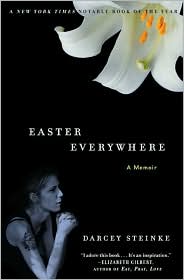
True Conversions No. 3: Darcey Steinke


Easter Everywhere: A Memoir
Darcey Steinke
Bloomsbury: New York, c. 2007
231 pp. $14.95 (paper)
ISBN: 1-59691-138-7

I once asked a friend of mine in Stockholm why so few Swedes ever bothered to go to church. His answer was both direct and revealing: “We don’t really need to; the influence of Lutheranism is so deep in our culture. In fact, we even have a saying: ‘Luther sitter pÃ¥ axeln,’ which means, “Luther is sitting on our shoulders.” It appears that author Darcey Steinke certainly started out in life with Luther propped up on her shoulders. But in the progress of her faith, as this intimate memoir reveals, she has made the clear decision to carve out her own spiritual space, Luther or no.

Steinke was born in upstate New York, into a clerical family¬-- a preacher’s kid. A Lutheran pastor’s preacher’s kid, in fact. Her earliest memories, she writes, “are of my father in cassock and white surplice preaching from the pulpit.” It’s clear that this and other early experiences have left a deep imprint on her faith journey. Her childhood and adolescence occur during the cultural revolution of the Sixties and early Seventies. Her parents’ spiritual progress during this same period reflects the disruptive influence of the times. Her father moves from the not so genteel poverty of pastor and parent, through a more secular calling as hospital chaplain slash social justice activist, to an ultimate return to church work three decades later-- as shepherd of a struggling inner-city congregation. The waning and waxing faith of her father coincides with the downward spiral of her mother’s ongoing clinical depression, as well as her growing estrangement from, and ultimate renunciation of any formal creed. In and through both of these broadly diverging poles, Steinke seeks to forge her own path.

When she was a child, her father spoke to her of a deity whose existence and presence in the world are both “infused” and infinite. She intuited that somehow God must be something like her dad, in a way: both loving and aloof. Her paternal grandfather, also a pastor, images a deity made of sterner stuff: stolid, humorless, even punitive. Her own search unfolds as a quest for a God who is more passionate, direct, and intimately involved people’s lives, an image that, understandably, she rejects. Later on, in adolescence, she finds her father’s faith struggles perplexing: “Outside of church I’d never seen him pray and he mostly read popular novels…. But his voice quivered as he blessed me (at confirmation), and I knew that his faith hadn’t gone completely, that he still clung to a particle of faith.”


Steinke’s own quest for belief continues through the struggles and growing pains of her teens and twenties: multiple family moves, a study term abroad and her first experience of love, relationship, breakup and heartache. A healing summer sojourn in South Carolina, accompanied by a peak into Penecostal exuberance. A subsequent move to New York, more studies, bouts of clubbing, druggy friends and acquaintances, an abortion, a frustrating relationship, the birth of her child. An emotionally excursive and itinerant life, to be sure, but one in which apparently aimless wandering metamorphoses into a dedicated search for spiritual succor. Lifestyle experimentation gives way to greater inner stability and a disciplined approach to prayer, spiritual reading and direction, friendships with fellow seekers, and the search for a stable worshipping community.

Through her persistent searching and longing, Steinke ultimately experiences something of an epiphany—a direct and intimate experience of the divine which is her own—neither inherited, borrowed, nor vicarious. She is at the University of Mississippi on a fellowship grant: “I paid the sitter and sat outside on my lawn chair. The sky was full of stars, like salt spilled on salt paper. I saw one fall, a quick arc of light disappearing over the horizon… I felt weirdly deracinated, but it was not a creepy feeling. My daughter and I were not, as I had so often feared, doomed characters in the opening sequence of a horror movie. I felt we were living in the eternal moment, residing inside infinity. I raised my hand up and held it before me as a sign.”

Back in New York, she endeavors to settle more firmly into her own life and literary career, She joins a church in her neighborhood—Grace Reformed—and is drawn to the passionate ‘presence’ of evangelical faith. She participates in a study group on Rick Warren’s A Purpose Driven Life. She connects with a spiritual director, an Anglican nun on Manhattan’s upper West Side. And, intermittently, she attends Catholic Mass.

By the books’s end, Steinke has reached her own, but still somewhat tentative conclusions about faith: “I am not able to break with Christianity, no matter how uncomfortable I am with many of its current manifestations. Biblical imagery and Christ’s message of forgiveness continue to haunt me, and I know my own redemption lies in Christian tenets, not in others’ religious beliefs.” She stakes her own ground within the tradition: “The idea of church still has a grip on my imagination, but I realize now that what I thought was held only inside those walls—grace and divinity—is actually located directly and authentically inside myself. Church is not a set of rules or a specific building,” she concludes,” but a way of life.”

There is an ambivalence here yet. Steinke is still not quite fully convinced, committed. She writes more about the Christian church, for example, and less about her direct experience of the Christ from whom the church (traditions, theology, people) has emerged. Still, even if Steinke is not completely at home spiritually (who is?), she is certainly in the neighborhood.

Monday, April 26, 2010

True Conversions No. 2: Sara Miles


Take this Bread: A Radical Conversion
Sara Miles
Ballantine Books: New York, c. 2007,
283 pp. US$24.99
ISBN: 978-0-345-48692-9

(As far as book reviews go, this one's a little late. Just after I finished rereading this conversion memoir by Sara Miles (published in 2007), I discovered that she has recently come out with a new title --Jesus Freak: Feeding, Healing, Raising the Dead—published just this spring. So now what? Well, I’m gonna write about what I’ve read, then order the new title from Borders, and then write about that later on. Sound like a good plan?--ct)

Take this Bread: A Radical Conversion, is a driving, passionately articulate narrative of a faith lived, loved and savored. If there’s such a thing as Episcopalian chutzpah, she’s got it. An experienced journalist and former war correspondent Miles is equally relentless and unsentimental in her spiritual quest. She forces one to realize from the get-go that there’s no such thing as a ‘conversion’: I came, I saw (the Light?), I conquered (or was conquered?), over and out. No. Miles makes it clear that life, all of life, moment to moment, day to day, is an ongoing process of converting. She appears to move in a Spirit-driven universe in which one is challenged constantly, consistently, and persistently to know, grow, and sometimes glow (wonderfully, even) amidst all the mayhem and messiness of life in order to understand and acknowledge Life and the Source of Life itself. There are bound to be collisions, but so what?


Miles doesn’t lean into conversion. She jumps heart-first right into the middle of things and then tries to figure out where to go from there. Apparently out of the blue and overnight, she moves from the stance a theologically uninterested bystander-- offspring of atheist parents (and, ironically, missionary grandparents)-- to that of a convicted believer. “One early, cloudy morning when I was forty-six,” she writes in the opening paragraph of this breathless narrative, “I walked into a church, ate a piece of bread, took a sip of wine…. This was my first communion. It changed everything.”

The ‘everything’ that has changed for Miles, starting with this initial experience more than a decade ago, includes her understanding of herself, of the nature of church, the centrality of communion, and the transforming power of sacramental life. Her “converting” process is fed and fueled by one vital discovery after another: “ The mysterious sacrament turned out to be not a symbolic wafer at all but actual food—indeed the bread of life.” In light of this epiphany, she begins to see the ways in which she, as a self-professed ‘outsider’ finds her own place within the communal narrative of the Christian faith: “I realized that what I’d been doing with my life all along was what I was meant to do: feed people.”


And feed them she does—with both zesto and pesto! Miles is fed by a profound and explicit experience of Eucharist, which in turn moves her into a direct and abiding experience of a particular church community—that of St. Gregory of Nyssa Episcopal Church in San Francisco’s Portero Hill neighborhood. Centered and centering at St. Gregory’s she is impelled to extend the Eucharistic experience and narrative literally—by dedicating herself to feeding others. With the help of a motley/godly crew of volunteers, she draws from years of restaurant experience to start a food pantry at St. Gregory’s, which over time morphs into a project involving a citywide network of distribution centers. The Pantry’s approach is a direct reflection of the congregation’s own inclusive promise: all are welcome, all will be fed, and all are invited to feed others. No questions asked.”

It is this openness of Communion and communion which, ironically, helps to ground Miles in Christian tradition. She constantly bristles at any sign of cant and hypocrisy in the church as institution, while just as constantly drinking deeply from the very depths of a living tradition that has somehow—miraculously-- survived, even thrived through centuries of alleged institutional fossilization. Welcome to the mystery.

The Christian faith of Miles is intense, kinetic. A kind of ‘in your face,’ but at the same time, ‘isn’t God great’ small ‘c’ catholicism. She has no patience for borders and boundaries she feels have been arbitrarily construed, constructed and defended through human selfishness, fear and pride. And her passion for ‘feeding’ the outsider of any and every description shines through it all. The Pantry is neither a service or a ministry as such; for Miles it is serving and ministering. Period.

With all this constant movement, one wonders: who, what, and where is its still and certain center/ Center? One has hints of this in Miles’ fidelity to the tradition of morning and evening prayer— a potent force in the Anglican/ Episcopal tradition and wonderfully expressed through the liturgical life at St. Gregory’s . But overall, Miles writes less about ‘being’a Christian than about ‘doing’ Christianity.

Like Mary Karr (see previous blog entry) and others, Miles’s converting is not always understood or appreciated by friends, family, and colleagues both beyond and within her faith community. Initially, at least, her decision is greeted by those on the ‘outside’ with skepticism, amusement, and indifference. Within the context of the church, she clearly struggles with the tension of another order—that of belonging to an institution which is all too often reactive rather than proactive in the proclamation and living out of Gospel values. Miles appears to understand that tension fully and is willing to engage it, wrestle with it. Rather than becoming frustrated and embittered, she continues to feed and be fed. And she challenges us as well: take this Bread (and live it)!

Monday, April 19, 2010

True Conversions No. 1: Mary Karr


Lit: A Memoir
Mary Karr
Harper: New York, c. 2009
400 pp. US$ 25.99
ISBN: 978-0-06-059698-9

One of the most interesting phenomena of our time from my perspective is that “a pesar de todo y en medio de todo”/”in spite of everything and in the middle of everything”—people continue to join the Catholic Church. At our parish alone this Easter, we welcomed 47 new Catholics—30 adults, teens, and children (no infants) were baptized at Easter vigil; an additional 17 were received into the Catholic community from other Christian denominations. In the Diocese of San Diego as a whole some 1400 neophytes joined the Church. Nationwide in the US, more than 100,000 people enter the Catholic Church annually. A pretty good indication, from my lights, that in terms of Church membership and attendance, there’s a fair amount of two-way traffic—people are leaving (no news), but other people are joining as well (pretty big news for us Catholics, I’d say). How come?

While I have a few hunches from my own pastoral experience as a Franciscan and as a priest, I’m also fascinated by the number of our contemporaries who have been willing to step forward and articulate their own conversion stories. Nearly two decades ago, I found myself sitting in an audience in San Francisco as author/ poet Annie Dillard spoke about her own unlikely embrace of Catholicism. The information was received with embarrassed silence followed by surprised gasps and giggles by her generally well-heeled and well-read listeners. There was no applause. I hadn’t know about that part of Ms. Dillard’s life, but she made it clear that her faith was important to her and that it illuminated her own artistic search and expression. I liked that in her. I still do.

That was then. More recently, I’ve become aware of a whole slew of “true conversions” stories appearing in print media– almost a sub-genre in itself. I find these tales of personal discovery fascinating. Why would someone choose Catholicism—especially now—especially given the media coverage of the sexual abuse scandals, in particular? What’s going on here? How is the Spirit moving in our time? What is s/he saying to us? What continues to attract intelligent and committed people to this faith community, while other equally intelligent and committed people appear to be leaving in frustration, bitterness, and contempt? I’d like to reflect a bit on some of the stuff I’ve been reading lately. It is, after all, all about ‘vocation’—listening for the clear, calm, gentle voice of Someone (maybe God?) inviting us into a deeper experience of love and community. In spite of, and in the middle of all the ‘stuff’ that goes on in our lives.


Writer Mary Karr can best be termed as a “memorist”. Her first works-- The Liars Club and Cherry—were both bestsellers. The former concentrated on her rough and tumble childhood in Texas. The latter dealt with her adolescent struggles. Karr’s third and most recent memoir, however, focuses on her spiritual journey and her unlikely path of conversion from, what-- Alcoholism to Catholicism? (Would it be fair to describe it as kind of a shift from one kind of‘religion’ to another?) So how did she get from there to here?

On the other hand, why not look at things in reverse—how did Mary Karr make her transition between here and there? “Time arcs back,” the author notes in the very last chapter, “carrying me in it.” She is visiting her mother—an aging, cantankerous, absolutely charming professional prevaricator and ingrate. Karr stumbles across an underlined passage in her mother’s Bible—Psalm 51—(“the hanging psalm”). The thing is, this is the very passage her spiritual director has prescribed for Karr’s Lenten reflection. She reflects: “… it feels as if God once guided my mother’s small hand, circa 1920-something to make two notes I’d very much need to find seventy years later—a message that I could be made new, that I am – have always been – loved.”

Karr’s conversion story ‘ends’ in its’ ‘beginnings’—the jagged trajectory that her life has made “arcs backwards” from love to Love. In between is all the ‘stuff’ that happens or that we make happen in our own stumbling, bumbling way. In Karr’s case the arc passes backwards and forwards through childhood misery, adolescent longing, youthful experimentation, catastrophic relationships, and toxic dependencies. In between and among all this, one is able to discern some slender, yet surprisingly firm threads of sustaining hope, stubborn discipline, and sustaining friendship and love. “A pesar de todo y en medio de todo,” she discerns presence of a loving God in her life, partly through the means and medium of her chosen call, the written word.

Where does the Catholic part come in? Maybe it was just some kind of crazy luck or random choice, but I think not. Again, my funny bone tells me that with Karr it may have been a matter of things “fitting”— the narrative of her own suffering and redemption coalescing with that of our own collective history and struggles. They fit. They fit well enough for her to embark on the path and serious business of making a faith choice and commitment to a specific community of worship and service. Whatever happened, it is clear that the point of entry into the faith experience for Karr was every bit as much through her pain as it was her brain. As she expressed it in a PBS radio “Fresh Air” interview: "I thought faith was a feeling. My intellect told me this was insane. The only way I was able to do it was through practice," she says. "[I'd] been trying to get sober and not really listening to the ways you're supposed to do it, and somebody said 'pray on your knees every day for 30 days and see if you stay sober.' And I just saw it as, like, self-hypnosis or like talking to yourself."

Karr’s journey is not unlike a lot of our own stories. What makes her tale particularly striking and convincing, though, is her gift of honest expression— by turns blunt, blue, raw, or reflective, yet ever relentless. Her seemingly constant and continuing collisions with crushing realities. Her ultimate deliverance from multiple and cumulative experiences of pain and suffering-- through successive dead ends to eventual recovery and spiritual awakening. Read the book for the details. It’s not always pretty, but it’s really real. Just like life.

Sunday, April 18, 2010

Jesuit Advice in a Franciscan's Life


Discerning the Will of God
An Ignatian Guide to Christian Discernment
Timothy M. Gallagher, OMV
Crossroad Publishing: New York, c. 2009.
ISBN: 987-0-8245-2489-0
$16.95, 160 pp.

Personally, I struggle a lot with decision-making. It doesn't come easily or naturally to me. It never has. Recently, though, I needed to make a decision—a really good decision—about an important matter in my life. And I wanted to get the best help and advice available. My spiritual director (a Jesuit, by the way) suggested this text, which I took along on a recent trip to read, study, and reflect (upon). I was looking for a practical, step-by-step guide which would lead the reader through the discernment process-- hopefully without too much stress or discomfort (!).


Timothy Gallagher’s guide to discernment in the Jesuit tradition clear, rational, user-friendly, and methodical. But it was not Gallagher's methodology which I found most helpful. Rather, it was his basic insight that the foundation for any and all good decision-making is an “awareness that God has created us out of love and ceaselessly offers that love to us.” The recognition and acceptance of that Love leads to a “consequent thirst for communion of wills with the One who so deeply loves us.” Peter, one of Gallagher’s spiritual directees, states things succinctly. Peter reports that at the age of eight, he approached his father saying, “Dad, everything we learn in church and everything in the Bible comes down to just one thing, doesn’t it? …. That all God wants us to do—all the time—is to ask him what he wants us to do, and then do it…. Instead of asking ourselves, ask God.”

Imagine. Good decision-making, for the Christian, has its foundation in our relationship with a loving God. For the adult, it is “the experience of ourselves as loved sinners, loved in our failures, faults, woundedness, and pain—loved in a way that frees us to seek moral newness and so creates a heart ready to discern.” (p.41)

The necessity of basing one’s discernment upon a foundation of love—God’s love (intimate, personal, and abiding)—transforms one’s experience of the ensuing process.Gallagher goes on to speak of the “disposition,” “means”, and “fruit” of discernment. And he provides a clear and accessible road map of the distinct and discrete “modes” of discernment provided in the writings of St. Ignatius of Loyola.

I was surprised by a couple of other aspects of the book as well. For one thing, Gallagher quotes extensively from the reported experiences of his spiritual directees over a thirty-year period. A fair number of these anecdotes are from women and men contemplating priesthood or religious life. This is particularly helpful and accessible to those on the path of vocational discernment.


The other surprise I experienced was Gallagher’s reference to several Franciscan sources. He refers for example, to an account of a Secular Franciscan, Blessed Peter Pettenaio, who reports his vision of Christ walking into the cathedral of Siena, surrounded by a throng of saints, each of whom tried (unsuccessfully) to place her/his foot into the footprint of the Lord. At last, the only one to succeed in the task was Francis of Assisi (Atta boy! That’s our guy! Whadda way to go, Francis!)

A more revealing and relevant reference, however, is the experience of Francis’s own clarity in eventually discerning his call: “Immediately, exulting in the Holy Spirit, he cried out: ‘This is what I want, this is what I seek, this is what I long to do with all my hear!’” (I Celano). Isn’t that the kind of clarity, focus, and determination most of would really like to have in our own lives?

This is a very good, practical, and user-friendly guide to spiritual discernment. It is not enough in and of itself, however, as the author wisely cautions. To be complete the process requires a disciplined commitment to spiritual practices (prayer, spiritual reading, reception of the Eucharist, silence) and the help and assistance of a skilled spiritual director. By the way, it was a great help to me in my own recent decision-making.//