Sunday, February 2, 2014

The Presentation of the Lord


Earlier this week, I attended a celebration of Catholic Schools Week here in Santa Barbara at Bishop Diego Garcia High School. There were about 1,000 people present.  Most of them were the students from the four Catholic schools in the area:  Our Lady of Mount Carmel, Notre Dame, St. Raphael’s and Bishop High School. It was a wonderful day and a true celebration. 

At the Mass, Archbishop Jose Gomez of Los Angeles told the children:  “I am going to speak to you about three things:  about Pope Francis; about how much God loves us; and about how much we need to love each other.”  Well, I’m not going to speak about Pope Francis, except to quote the Archbishop, who, noting that the Holy Father was on the cover not only of Time  magazine, but also of Rolling Stone, acknowledged the Pope’s popularity and concluded:   “ I guess that means we have a cool Pope.”

Well, we certainly know that about the Pope, so I’m going to talk about the other two things the Archbishop mentioned:  about how much God loves us.  And about how much we need to love each other.  It’s really the subliminal message of every single Gospel proclamation, isn’t it.  But today, we are asked to consider it through the words of today’s Gospel from Luke.

Today is a day that goes by a number of names and titles, depending upon history, tradition and geography.  We Christians in the Western world call it the Feast of the Presentation of the Lord.  But previously, we have called it the Feast of the Purification, or Candelmas, the day on which all the candles are blessed in church for the year.  Our brothers and sisters in the Eastern churches call it the Feast of the Meeting of the Lord—a wonderful title.  And our brothers and sisters glued to their television sets this afternoon call it Superbowl Sunday.  No matter what we call or how we celebrate this day, though, we recognize that it is special.  A break in our daily routine.

In our very busy world, we not only accept, but we expect and even anticipate such interruptions.  Practically no commute is complete without a crash or a breakdown.  It is not uncommon for our tv programs to be interrupted by ‘special announcements’ or subtitled updates of everything from riots to elections to stock market announcements.  And the banners on our Google or Yahoo! Homepages make pseudo-announcements about celebrity shenanigans and shopping tips on an hourly basis.  It happens so often that it’s difficult to separate what is important from what is hype; from what is really just  momentary and trivial.

What is happening in SS today is really important, not momentary and trivial. The normal rhythm of Ordinary Sundays, one falling rhythmically after the other, has been interrupted for a special announcement.  Instead of following the sequence of the public ministry of Jesus, we are suddenly jolted into another awareness and reality. We interrupt this Gospel for a special announcement.  Today is the Feast of the Purification of the Lord. It is 40 days after Christmas. Can you believe it? The Israelites spent 40 years in the desert. Jesus spent 40 days in the wilderness to be tempted by the Evil One. In little more than a month, we will be entering into the 40 days of Lenten preparation for Lent.

So what is happening here?  Jesus, 40 days after His birth,  is being presented to the Lord.  In compliance with Law and tradition.  And in fulfillment of the Scriptures  In the prophets Simeon and Anna, the Old Dispensation meets the New.  And Jesus, for the first time in the city of Jerusalem and in the Temple precincts, is recognized as Messiah by people officially recognized as representatives and servants of the Lord and His People.

Simeon literally lifts up the infant Jesus to the Lord.  Jesus, Himself the Redeemer, is symbolically “redeemed”—bought back—in a ritual which acknowledges that all of Life is from God and belongs to God.  (See Exodus 13:2). In a ceremony prescribed by Scripture and tradition, this firstborn male child is “presented’ to the Lord in recognition of the reality that He belongs to God in the first place.  And then, He is “redeemed” or “purchased”—bought back by his parents with the ritual offering of turtledoves/ pigeons.


Simeon lifts up the Lord. And then announces that his work is done and he is ready to die.  In like manner, Anna, the 84 yo prophetess appears on the scene to corroborate the testimony of Simeon. Her work and vocation have been fulfilled as well.

But what about  us?  Every story about Jesus is addressed to, involves, and implicates us as well . We never  remember or commemorate an event in the life of Jesus just for its own sake. We always celebrate as well.  And a celebration is always right here and right now.  The Presentation is present.  Simeon lifts Jesus up to the Lord and leaves the scene.  Now, Jesus lifts us  up to the Lord but will never leave the scene.  In this story, Luke reminds us.   That we, too,  have come into this world not by accident by through the Love and  loving design of God. That we belong to God first most and always. That Jesus lifts us up to the Lord and “redeems” us by the sacrificial offering of His Life and His Love.

When we gather around the table of the Lord as a Eucharistic community. The priest says:  Lift up your hearts. And we answer:  We have lifted them up to the Lord. By saying this we simultaneously acknowledge that it is Jesus who lifts up not only our hearts but our entire being to the Lord.

He lifts us up out of soul-wearying repetition and deadening routine.  He lifts us up out of frustration and despair.  He lifts us up out of boredom and fatigue.  Lifts us up from our pain, suffering, and grief.  Our confusion, doubt, and fear. And He presents us- in His embrace and in His love—to our Creator—a loving and gracious God!

In all of this, we are called to recognize that the Lord lifts up all of His people, not just ourselves alone. So, we need to respect and reverence them every bit as much as we do ourselves.

We interrupt this regularly scheduled program to announce, to remember and to celebrate what we  must never forget:  That God is always present to us.  That God really does love us.  And that we must love and reverence each other as well. And strive to be truly “present” to God, to ourselves, and to each other as well. 

Monday, January 27, 2014

Homily for 3rd Sunday in Ordinary Time: Follow Me and I will make you fishers of men


Jesus has called and chosen… us! Today’s Gospel from Matthew (Chapter 4) reminds me of an experience I had once while visiting the Bay Area.  I was roaming around the side streets of North Berkeley, close to where our  Franciscan School of Theology use to be, and I noticed a rather large van parked in someone’s driveway. On the side of the van was a sign indicating that it belonged to Time After Time, Inc.,  a firm specializing in cryonics.  You know, cryonics?  The hope, belief and practice on the part of some that it is possible to take the body of a person who has recently died and preserving it at extremely low temperatures.  The thought is that one might, at some point in the future,  be able to resuscitate the corpse,  given the possibilities  of scientific advancement and so on.  It is a complicated and, by the way, very expensive enterprise.

So, anyway, as he looked at the van and noticed its quirky logo, my walking companion quipped, “Oh, I get it.  ‘Many are cold, but few are frozen.’”. . . .  Okay, so maybe it isn’t exactly what the message is for today, but it may help you remember what the real meaning of the Gospel is. The real theme of the Gospel, of course, is quite closer to the statement :  Many are called and few are chosen.
And that’s exactly what is happening in today’s Gospel.  Jesus is calling and choosing.  And by the way, He quite deliberate and methodical in both  His decisions and in His actions.

First, let’s put this all into context.  Jesus, after His baptism by his cousin John in the Jordan, has moved into the desert for a period of period of fasting and prayer lasting some 40 days.  Now, John has been arrested and Jesus is on His own for the first time.  Completely on His own.  And He makes some important decisions.  Some important choices which will have a profound effect upon His mission.
First of all, instead of returning to His hometown of Nazareth in southern Galilee, Jesus chooses to center his itinerant ministry in the strategically located fishing village of Capernaum in northern Galilee, some 45 miles due north.
Capernaum is located alongside a major trade route called the Via Maris, or the Way of the Sea,  originating in Damascus and terminating in Egypt.  It was the equivalent of  a major superhighway, if you will, in Roman times.
Secondly, Jesus chooses to situate His ministry in Galilee.  Note, Galilee. Not Jerusalem, the capital and center of Jewish worship in the Temple.  Galilee is “the sticks”, the boondocks.  A remote region which is ethnically and culturally mixed in which only about one-half of the population are Jews.  It is, by definition, then, ritually impure and contaminated. 

After calling Capernaum of Galilee his new home, Jesus proceeds to call and choose His disciples, His apostles.  Once again, His choices are surprising and even confusing.  First of all, Jesus does the picking—in a complete reversal of Jewish cultural norms  which dictated that students pick their rabbis/ teachers and not the other way around.  No, Jesus does the picking, the choosing.   And He does it in a very deliberate way.  He chooses ordinary people.  Not  Temple priests, not scholars and academicians.  Not even reformers—members of the Pharisees.  He doesn’t even choose among the contemplative Essenes,  whose community was prototypical of monastic life.

No. Jesus calls and chooses fishermen—businessmen who are rooted in their trade and anchored in their family and community life.  He calls people away from their primary responsibilities and identity to something totally new.
So, He picks and chooses. And He calls.  Each and every single one personally and by name.  And, if the Scriptures are to believed, He calls them in a very simple and direct way.  In ten words or less:  “Come, follow me, and I will make you fishers of men.”  Period.

Amazingly, and nobody to this day knows exactly how or why, they respond to the call, drop everything, and follow him.  But the story is not over.  Jesus does one more thing.  He has chosen his location (Capernaum).  He has chosen his disciples.  And now He literally takes up where John the Baptist has left off.  He has chosen His motto and byword:  “Repent, for the kingdom of Heaven is at hand.”

Jesus has called.  And chosen.  Both then. And now.  Because, you see, Jesus has called and chosen… you and me.  In baptism, He, as a member of the Trinity,  has taken up residence and set up shop in our hearts and minds, in our bodies and souls.  He will not budge and He cannot be evicted.  So we’re stuck with him.
Secondly, He has chosen each one of us by name.  To be and to become His follower and friends.  Elsewhere, in the Gospel of Mark, we are told that Jesus picked “those whom He desired…. To be with Him.”  And so it is with us.  Jesus wants us to be with him. Literally to keep Him company.

Not only that, Jesus has called us to himself so that he can send us to others.  To be with and for others as  His personal representatives.  To preach the coming of the Kingdom of Heaven in practical, down to earth terms. To show others as Jesus shows us, that we are called and chosen for life.  For  peace.  For  justice.  For serenity.  For community.  For love. and out of love.  So, if you are feeling cold and frozen, it’s time to thaw out.  Called and chosen is what we are.  And we’re stuck with it.  Called and chosen to receive, to be, and to share:  Love Himself.


Sunday, January 19, 2014

Homily for 2nd Sunday in Ordinary Time: Behold the Lamb of God!


When it comes to faith, believing is seeing.  And not the other way around.
What a difference a week can make.  Even when  it comes to Scripture.  If today’s Gospel account sounds familiar, it’s because it is. It is exactly the same Gospel account as last week’s:  the story of the Baptism of the Lord. The only difference, however, (and it’s a significant difference) is that last week’s account is from the Gospel of Matthew (chapter 3) and today’s story is from the Gospel of John (chapter 1).

Matthew’s account is fairly straightforward.  Neither the narrator nor any of the characters get in front of the camera or block our view of the Baptism of Jesus by his cousin John.We hear  the words of Jesus.  We hear the words of John the Baptist.  We hear the words of God the Father, together with his Son Jesus and in the Presence of the Holy Spirit.  It’s all there, right in front of us, with all its drama and immediacy.

But John’s Gospel gives us a very different twist.  John does all the talking.  All  the talking.  He is off-camera.  It’s almost as if he were being interviewed alone, sitting calmly and comfortably in someone’s home or garden. (Or more likely in his case, squatted in a dank prison cell awaiting his execution).   Nevertheless, John is reflecting on an experience of Jesus.

What is going through John’s mind and heart as He sees Jesus coming toward him?  First of all, they were not strangers.  We know from elsewhere in Scripture that John and Jesus have been intimately connected their entire lives:  They were cousins. Born just six months apart.  Their mothers were very close-- so close that Mary, pregnant herself with Jesus, travelled a great distance to see Elizabeth, the mother of John, and to stay with her during her confinement.  And we know that both mothers intuitively knew that there was something very special about these births.  Especially  the birth of Jesus.  And that John even leapt in his mother’s womb when the two women met.

That’s the back story.  Or only a part of it.  They were family, blood relatives, the same age.  They had to have grown up together.  Visited each other, seen each other at family weddings and funerals.  Played together as kids.  So. Why, then, does John not say (or think):  Oh.  Here is my cousin, my kinsman, Jesus!  What brought him here to the Jordan today?  Is he coming to be baptized as well?  Well, I’ll be….  No.  John says (and thinks and feels):  It’s Him.  He is the One.  I’ve always known there was something special, something different about him.  And I’ve been watching him carefully all these years.  It’s Him. The One who has existed  before all time.   The Promised One.  The One I have been told about in answer to my prayers.  The One I have been instructed to watch out for.  It’s Him!  It’s the Messiah! 


I used to know him as just my cousin.  But now I see Him for who He really is.  He is the Lord.  So I called him the Lamb of God.  That was the first thing to come to my mind.  And, actually, it fits him.  Perfectly.  Now that I think of it.  After all, lambs are sacrificed daily in Temple worship.  But there is only One Lamb—for whom we have been waiting—to fulfill and complete all of our symbolic rituals.  It was the lamb our ancestors smeared on their door lintels at Passover which secured our liberation from the slavery of Egypt.  And, now here is God’s very own Lamb, who will one day be sacrificed for our account.

What does this all have to do with you and me?  When it comes to faith:  Believing is seeing.  And not the other way around.  John saw Jesus.  A lot.  Throughout his live, presumably.  But it was only gradually, over time, that John began to believe Jesus.   And to believe in Jesus.  And that is Good News—Great News, even—for you and for me.

Believing is a process:  day by day (sometimes even moment by moment) over time by which we come to see the presence of Jesus more clearly in our lives and in our world.  And in ourselves as well.  It takes time and energy and commitment and discipline to cultivate this awareness and receptivity.
Belief grows through prayer. Through study.   And reflection/ meditation. It grows, gets tested (and either strengthened or weakened) through  our interactions and relationships with other people on a daily basis.
It is renewed, refreshed, and regenerated through community.  And for us, in our Catholic Christian tradition, through the life of the sacred moments—the sacraments we share.  Most especially and beautifully through the Word and Eucharist we share.


We can lose our faith, watch our beliefs shatter and crumble.
Or we can hang on, hang in, lean into our beliefs in good weather and in bad. Often until  the storms pass.  Until, like John, we gradually begin to see.  Jesus is the Lamb of God.  And He does take away the sins of the world.

Happy are we who are called to the supper of the Lord…. When it comes to faith, believing is  seeing.//

Sunday, January 12, 2014

Homily: The Baptism of the Lord


Today is the last day of Christmas. To prove it, I am holding in my hand the last poinsettia of Christmas.The time for poinsettias is over.  The same goes for Christmas trees. If you’ve been secretly holding onto your Christmas tree in a corner of your house  until  now, please let it go. Before the Fire Department has to deal with it in another way. Seriously, though, the Church has been holding onto Christmas for three full weeks now.  Not in any secret way, but in a quite deliberate and public fashion no matter what anyone thinks.

Because Christmas is a season.  A time whose power and beauty are so immense that we cannot unwrap it, unpack it , and admire it all in a single day.  And then exchange it for something else on the next.  And we dare not do so. Instead, we stretch out our Christmas to make it last as long as we can.  Right from the birthday of Jesus through the feasts of the Holy Family, Mary the Mother of God (aka New Years Day), the Epiphany, and today.

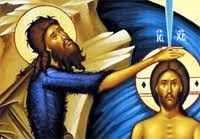
Today, we celebrate the Baptism of the Lord. A baptism is a bath. A ritual bath started by the cousin of Jesus, John the Baptizer, as a public gesture of a personal decision to ask for forgiveness and to change one’s life. In today’s Gospel from Chapter 3 of Matthew, we encounter Jesus standing in line with everyone else to accept a ritual cleansing, or baptism, from John.

John is both famous and feared.  He is acknowledged— even by his enemies—as a genuine prophet.  The first authentic prophet  to be raised up among the Jewish people in centuries.   His mission and ministry were credible because he walked the talk.  His  ascetic and prayer-filled lifestyle matched his words.  John surprised, intrigued,  and fascinated people. He did not seek to raise up an army or declare any sort of violent insurrection.  Rather, he preached a life of repentance and of conversion.  So people, hungry for authentic change in their lives, came to John.  Even to the boondocks beyond the capital, Jerusalem.  Hungry for change, they lined up to make a public acknowledgment of their sins and to accept baptism at his hands.

Now I can imagine that there were two lines for this baptism.  The first line was the “IN” line:  with a great number of people looking quite nervous and tentative.  Sheepish,  even.  These were the obvious sinners-- the people about to receive their baptism from John.  The other line  was the “OUT” line:  of people were those who had just been baptized.  They were all grins as they were handed towels, dried off, and got ready to celebrate with their friends.

Jesus decided to get into line with everyone else.  But He got into the “IN” line instead of the “OUT” line.  Why in the world did Jesus get into the wrong group?
After all, Jesus was not a sinner. He did not need to be baptized.  So, why did He get into the wrong line? This is where the Scriptures start to stutter.  Members of the early Christian community certainly found the presence of Jesus in this scenario both embarrassing and disconcerting.


Matthew tells us there was a discussion between John and Jesus.  John was reluctant.  You bet he was.  And Jesus was insistent.  Stubbornly  so.  In the only way that one cousin can be with another.  People were waiting, fidgeting.  And they were at a stalemate.

Then Jesus said he had to be baptized so that ‘all righteousness might be fulfilled.’
What does that mean? He was talking in code.  A ‘righteous’ person was one who was completely open to God’s will. More  than that.  A person who makes the decision to surrender completely  to God’s Presence and Power in his life.

Jesus, in the 30th year of His life, had finally attained the status of full adulthood as a Jewish male.  With His baptism, He proclaims for the first time His complete openness to God’s will—to the will of His Father—in His life.  Finally,  John relents and baptizes Jesus.  And then, something radically new and extraordinary happens.

In this ritual breaking through from death to life, Jesus breaks through to heaven.  The barrier between heaven and earth is pierced.  And God, in the presence of the Spirit, acknowledges His Son.  And by extension, God acknowledges and blesses us.

The baptism of Jesus changed absolutely everything.  He didn’t get into the wrong line on purpose for His own sake.  He did it for ours. He wanted to show that His greatest desire was to be right down here among us, close to us, as one of us.  And that changes everything.  It means our own baptism as Christians can never be the ritual, symbolic baptism of John.  Ours is the baptism of Jesus. In Jesus. And through Jesus. So, when we are baptized—once and for all—the heavens open for us as God claims us as His own.  Once and for all.  Once and for always.


Our baptism is the beginning of our special life with God in the community of faith, the community of the friends of Jesus.  It is not just a single, historical event.  It’s more like a time-release capsule.  It’s power is so strong and enduring that, like the prolonged Christmas season itself,  it releases itself throughout our lives.  Not just in a single spiritual photo op.

It is the power of identity.  Of being and  belonging.  To God and to His People.  Of knowing who we really are and whose we are, no matter what we do or say or what happens to us in our lives.  It is so powerful that it transcends the petty differences that separate one group of Christians from another. After all, there is only one baptism in the Lord.  It’s so powerful we can’t even take it away from ourselves.

We are first, last, most and always children of God, members of a family of faith.  Baptism is our birthright as Christians and no one can ever take it away from us.

So that what the Father says to and about Jesus, the Father says to us and about us:  “This is my beloved son. This is my beloved daughter.  You are my beloved son.  You are my beloved daughter.  In whom I am well pleased.” And He IS pleased with us.  Very pleased indeed.  So pleased that he sent His Son as our Shepherd.  To be in our midst. Jesus was baptized and the heavens opened.  But after that, Jesus stuck around and is still with us. It is our lasting Christmas gift on this last Christmas Day.