Monday, September 13, 2010

72 Hours at Mission San Luis Rey


(Above): The historic church at Old Mission San Luis Rey, Oceanside, California (founded 1798). Capacity: 350. Visited by more than 250,000 tourists annually. (Below) The Serra Center at Old Mission San Luis Rey, Oceanside (completed 1996). Capacity: 1600. Visited by members of our 6,000 family parish weekly: Please note. These buildings do NOT move (except during an earthquake, God forbid); everything else around here does. Constantly.

Friday
September 10
9 AM

I’m sitting in my office; the door is locked. No visitors. Teleconferencing with other members of our Province leadership about finances. The meeting lasts a full three and a half hours, with one 15-minute break. I don’t want to see another financial report. Ever again.


3 PM.
Home at the friary. Father Larry is returning from his vacation in New Jersey. Father Adrian is returning from Ireland tonight (who’s going to pick him up at the airport?) Father David is packing for a two-week trip to Kazakhstan. Father Luis and Brother Kelly are flying in from a meeting in Oakland. Brother Rufino is arriving for an overnight (he arrives and departs unseen). Another guest, Father Juvino, a diocesan priest from Goa, India, has been here just two days. The only friar one home for sure is Brother Mo (85), who is in his room watching a baseball game.

6 PM. Getting ready for the ninth annual Rotary Club Crabfest, a community-wide celebration/ fundraiser held in the Mission Gardens. Even before it starts, it’s been a great success: sold out, all 500 tickets. Both the Mission as well as the Parish social concerns office are beneficiaries. Veterans bring their own tools to crack crabs; a parishioner who owns a bakery got up at 2am to make 65 loaves of French bread.


The weather and garden setting are perfect; the music is great. The guests, representing every part of community life in the area, are relaxed, happy, and ready to eat! The Rotarians are working hard; the serving goes like clockwork. (Later on): I left the party early, gave up the ghost at 7:30 and took to my room. Slept through all the great music, missed some of the fun. This morning the courtyard is clear; the retreat center is preparing for weekend visitors.


Saturday
September 11


7:30 AM The ninth anniversary of 9/11. The flags in front of the Mission are at half-staff. The parish chapel (capacity 250) is full for morning Mass. Not unusual in our 6,000-family parish, but today is special just the same.The mood is somber; people remember where they were, what they were doing, how they reacted that day. Lots of spontaneous petitions during the Prayers of the Faithful—for the victims of Sep.11, for our military families (we’re next door to Camp Pendelton). For peace. After Mass, the Knights of Columbus lead about 100 worshippers in a scriptural rosary, part of a nationwide commemoration.


9 AM
This weekend's parish bulletins are ready and a few early birds have already snapped up advance copies. I head over to the Serra Center to give a short presentation to the English-speaking catechists in our religious education program (900 kids, 60 catechists). Brief talk on Franciscan spirituality, then off to hear confessions (Sacrament of Reconciliation). There’s a long line; the allotted one-hour time slot turns into almost three. Afterwards, I go next door to spend an hour with the Spanish-speaking catechists and give another presentation, along with a “dinamica” to get people moving. Lots of feedback and suggestions about what the parish needs.


3 PM
Quick late lunch, quick late nap. Then, literally across the street to the annual hoedown benefit for our neighbors at the Ivey Ranch, a great community-based noprofit organization that enables both disabled children and adults (especially Wounded Warriors—returning vets with combat injuries) to experience healing and growth through equestrian training. What could be more Franciscan? Try Canine Companions, in the same complex. They match up disabled folks with guide dogs. And then there’s Casa de Amparo, too, which helps women and their kids who are victims of domestic violence.


6pm
I have to skip the dinner at Ivey Ranch so I can get back to the parish for the 5pm Mass. The Gospel from Luke 15 is about the woman with the Lost Coin. After Mass, a woman approaches me: “I’ve lost my husband.” “Oh, I’m so sorry. When?” “Just today.” “Today? Oh my.” “Yes, Father, he was just here a minute ago, but I can’t find him anywhere.” “Oh (relief). I’m sure he’ll turn up.” (He was waiting for her in the parking lot the whole time.) Case closed.

Sunday
September 12
8 AM

“Meet and greet” as people leave morning Mass at the Old Mission Church. The sound system is working better, but no cantor this morning. David, the accompanist, did his best, but he’s not a singer. He was not amused…. I head over to the Serra Center to chat with members of our Guamanian community who are in charge of food sales this weekend: the standard cupcakes and doughnuts, plus wonderful soups—chicken noodle and corn w/ chicken. Not my usual breakfast, but tastes great!


9 AM
Say ‘hi’ to people coming out of the 8 AM Mass and then head over to another meeting hall, the McKeon Center, to welcome parents (English-speaking) who are registering their kids for religious ed/ sacramental preparation. I tell them (and I really mean it): I don’t know how you all do it. You have such busy lives with work, driving the kids to practices of every kind, taking care of relatives, dealing with financial stress and under/unemployment sometimes. And yet, you’ve made the decision to rear your children in the Catholic tradition—at a moment when we’re not exactly the most popular denomination on the block.


Back to greet people arriving for the 10 AM Mass, making a detour to bless one very large van. Run into lots of families with kids: “How’s school going?” “Good.” A burly, middle-aged man approaches me. John. Turns out he is Armenian and a truck driver. “I passed this place twelve years ago and promised that I would visit it some day. So here I am with my wife and mother.” Three women (sister all—one from Pennsylvania, another from West Virginia). The third one from New Philadelphia, Ohio. (Hey. That’s my mom’s hometown. We hug. Six degrees of separation. Works every time).

The “lost coin” theme continues: I misplace my keys (ALL my keys) and a volunteer from the parish library tells me: “Father, I can’t find one of our books, but I’m embarrassed to tell anyone. The title is Where is God? (I’m not making this up). We both pray to St. Anthony. I get my keys back by noon; haven’t heard anything about the library book yet.


12 Noon
Spanish Mass. This is the weekend of Independence Day for Mexico and, I am reminded by a lady who shouts it out during Mass—that of Central America as well. Father Luis is presiding; Fr. Adrian and I are there to show solidarity. The choir members, along with a lot of other worshippers are dressed in green/ white/ red combinations, in homage to the Mexican flag. The Serra Center is packed; the mood is jubilant. And the kids are noisy, but so what. Luis tells the people: “Let’s continue this Eucharistic feast by going across the way to our “Fiesta Patrias.” We applaud all the members of the parish Hispanic Committee/ Comite hispano and then bless the four young women “candidatas” who are vying for the title of “reina”/ queen of the fiesta.


All afternoon

Fiesta time. Cool, sunny weather. Families relax, stroll around the grounds, listen to great music, dance, and eat and eat and eat. The vendors are out in full force: carne asada, tamales, enchiladas, elotes, tortas, pupusas, aguas, flan—you name it. All of it incredible. Fr. Luis and I meet, greet, and eat. And eat.

6 PM
I take a break for a sick call and a nap. Back to “meet and greet” for the 5pm liturgy and make sure Fr. Tom has everything he needs for Mass. In the sacristy, he’s eyeing the bag of homemade oatmeal cookies a parishioner gave me. I gave him my “don’t even think of it” look, then relent and offer him one for after Mass. He accepts. Back at the fiesta, it’s time to listen to the mariachias, join in a bit of the dancing, and then get up on stage announce the winner for the pageant and crown this year’s queen. All the candidates are given warm applause and each receives a scholarship award to help her with her studies. After the coronation, I head home to crash.


Monday
September 13

9 AM
This is the Serra Center (again). Please note: it does not move. Except during an earthquake, God forbid. Everything else around here does. Constantly. Peace and all good!

Wednesday, September 8, 2010

Meeting our Mentors: The ExMinProvs


ExMinProvs? By way of introduction and explanation, the Franciscan universe is organized into approximately 117 mostly geographical entities called ‘provinces.’ The work and life of each province is directed by an elected Minister Provincial in consultation with a group of advisors, or ‘definitors’ who assist him. Former ministers provincial are sometimes referred to affectionately by the moniker "ExMinProvs."

I am myself a definitor in my province and serve as part of a six-member consultative team elected to assist our provincial minister, Fr. John Hardin (Numero Uno) and his vicar, Fr. Ken Laverone (Numero 2). Six times a year, we gather for 4-5 days at one of our retreat houses to consider the business of the province and make plans, recommendations and decisions. Basically, it’s like doing jury duty. We sit sequestered for long stretches of time, reviewing in detail an array of complex issues (financial, legal, personnel, etc.,) and hold consultative votes on specific agenda items. Discretion goes with the territory; all of our discussions are confidential. The process is thorough and generally effective; it can also be bone- tiring and soul-wearying. By the end of most sessions, we're ready to take the very next plane home.

Often our meetings are predictable and routine, but our most recent Definitorium session (August 29- Sep 2) was a welcome exception. For one entire morning, we suspended our working agenda to listen to presentations by a panel comprised of all five of our past ministers provincial-- hence, the term “Ex-Min-Provs”. For several hours, these extraordinary men mentored us collectively and spoke about the challenges and opportunities they encountered and experienced during their terms of leadership. In doing so, they provided not just an historical reflection on their time in office, but more importantly, valuable insight into the meaning of leadership over time in the Franciscan context.

So meet the five ExMinProvs. Their shared experience of leadership spans the past forty years of life in the Church and the Order. Several of them were trained by men whose experience of Franciscan life, in turn, reaches as far back as 1950:


Father John Vaughn: Minister Provincial 1976-9; Minister General of the Franciscan Order (OFM), 1979-1991). His initial six-year term was cut short by his election as Minister General of the Franciscan Order (OFM), a post Fr. John held in Rome for a total of twelve years. A prudent, soft-spoken man, he is respected for his ability to listen deeply to others and to serve as a conciliatory voice in discussions of ‘hot button’ issues affecting the Order and the Church. He has brought a heightened sense of international awareness to our province and the Order.


Father Louis (Louie) Vitale: Minister Provincial (1979-1988). Louie moved up from to the position of MP with the election of John Vaughn. A former US Air Force pilot, after completing a doctorate in sociology at UCLA, he went on to become a prominent figure in peace and justice work nationally. In recent years, he has been arrested and jailed on multiple occasions for acts of civil disobedience at places such as the Nevada Desert Test site (for atomic weapons research) and Fort Benning, Georgia (site of the controversial School of the Americas).


Father Joseph (Joe) Chinnici. MP (1988-1997) With a Ph.D. in history from Oxford University, Fr. Joe presently works as a professor and academic dean at the Franciscan School of Theology, Berkeley, CA. In all of his work, he has consistently stressed the necessity of reclaiming and renewing our Franciscan history and intellectual vision. During his tenure as Minister Provincial, he responded to the gravity of the issue of clerical sexual abuse with transparency and compassion.


Father Finian McGinn: MP (1997-2003). An accomplished linguist, Fr. Finian holds a Ph.D. from Fresno State University and worked with the Hmong immigrants in California’s Central Valley. As Minister Provincial, he brought a keen sense of awareness of our increasingly multicultural Order and society.


Father Melvin (Mel) Jurisich: MP (2003-2009). Also an educator, Fr. Mel served as Provincial Secretary for more than two decades prior to his election as Provincial. His by-word has been ‘transparency’—a willingness to share accurate and meaningful information with friars and the public at every level.

These men have been the heavy hitters of our Province. Individually and collectively, they have risen to positions of leadership during times of intense turmoil and growing polarization in both the Church and society. Each has succeeded in a significant way in maintaining a ‘center of gravity’ in our community life and service in the midst of this upheaval. As a province, we have been blessed; we appear to have received the ‘right’ leader at exactly the moment when we needed him most. These are all capable men who have been able to discern the ‘prevailing passion’ of the time and to channel that energy into the fulfillment of the deeper goals of our Franciscan vision.

So, what pearls of real wisdom were we able to gather? The ExMinProvs laid out for us the tremendous re/evolution of structures and issues that have emerged over the past forty years in the Order, the Catholic Church, and in society as a whole: the impact of Vatican II; the movement to a less hierarchical, more consultative style of leadership and participation; collaboration with the laity, and the adaptation of decision-making processes and structures to deal with increasingly complex issues. They organized their comments into five general categories of discussion: governance; dreams and their realization/ frustration; self-care; challenges, and the distinctiveness of the Province of St. Barbara

“We discovered that feeding the poor was not enough,” reflected Fr. John Vaughn. “We needed to change structures.” By the end of Vatican II, friars were leaving a quasi-monastic environment in order to serve people more directly. Friars were now intensely involved in hospital work, in parishes, and among immigrant farmworkers—especially in California’s Central valley. The shift in ministries was contemporaneous with rapid changes in the structure of religious life. As exMinProv Joe Chinnici noted, “In the period 1961-72, approximately 110 friars left the Province (out of a total of about 400).” Those who remained, reflected Mel Jurisich, had to deal with the serious issues of “ the loss of fraternal life, loneliness, and (the need) to rely upon (one’s) inner resources. We became more individualized in order to survive.” There was a hardening of attitudes on social issues and lifestyle choices (“I’m poorer than thou”) and a sense of increasing isolation.”

Institutionally, friars had to deal with a steady stream of complex issues— both intramural and societal-- that their predecessors had been spared: participation in the Social Security system (friars had not participated in the system until about 1970 because of an expressed desire to maintain strict observance of the vow of poverty), sexual abuse, health care for the elderly, possible bankruptcy. “We needed to see the bigger picture beyond ourselves, “ Father Mel observed. “And to understand that it takes time to move people forward together.” In the matter of Social Security, for example, it took friars nearly 12 years to agree to enroll in the government program. Addressing the ramifications of the sexual abuse cases has consumed much of the energy of leadership from 1993 to the present. Realignment, or ‘right-sizing’ of ministerial commitments has been a matter of discussion for more than a decade now.


All five ExMinProvs concurred that in today’s Church and world, crisis management is normative. In each of their administrations, “circumstances shaped one’s ability to lead as each generation faced new issues”, as Chinnici observed. Rather than being consumed by crisis, though, he suggested that future leaders learn “to shape the agenda given to him/ them so as to turn it towards the good and further the deeper goals of the (Franciscan) vision.” In practical terms, he suggested, this requires that the leader “discover the prevailing passion-- internationality, justice, Franciscan vision, culture, transparency, and so on.” Any given issue needs to be subsumed into the larger whole in order to “enable persons to… move forward.”

Remarkably, given the enormity of the tasks each and all of these men have had to undertake, none of them voiced any bitterness or resentment. Each appears to have developed the capacity to ‘lean into’ an issue rather than be overwhelmed by it. To seek help and advice, as Louie put it “from people who know a heck of a lot more than I do.” And to keep before them ‘the greater vision of life’ that Chinnici has articulated: “the dignity of the person, the need to create fraternity in mission, the decentering (sic) of politicization of issues towards something greater which we hold in common, (and) the inclusion of all in sorting out the tensions.”

The leadership of the Franciscan province of St. Barbara, like that of many other religious communities in the Catholic Church today, continues to struggle with the need to deal with the world one has inherited, to muddle through the messiness and complexity of daily life, and to face squarely both one’s own shortcomings as well as the reality of the unforeseen consequences of one’s decisions. The problems won’t go away, but they can and must be addressed in terms of the greater vision: “We’re not corporate CEO’s,” concluded our present Provincial Minister John Hardin, “ nor should we act like them. We Franciscans have our own culture and way of looking at the world.” It is the trust in that Spirit-led ‘way of looking at the world’ which continues to feed our dreams and guide both ex-, present, and future provincial ministers.

Monday, September 6, 2010

Summer 2010: Friar Days at San Luis Rey


The invasion began peacefully enough. Precisely around dawn (Franciscan time) on Sunday, July 25, while some friars were still fast asleep in their beds and others were preparing for Mass, the vans rolled silently onto the grounds of the Old Mission. The new occupying forces--fourteen student friars in all—nine of them from our own Province of St. Barbara— quietly gathered their backpacks, laptops, and sleeping bags to set up summer camp. The Mission would never be the same again.

Welcome to unofficial Friar Days at Old Mission San Luis Rey, Oceanside, California. For almost a full month, Franciscan friars, secular Franciscans, parishioners, families and friends gathered at the historic (founded 1798) 50-acre site north of San Diego to celebrate and share our heritage and hopes through a number of classes, workshops, and special events.

First off, the student friars spent time in summer classes on Franciscan philosophy—Sister Mary Beth Ingham offered a course on Franciscan philosopher Duns Scotus. Our own Father Tom Herbst, home for the summer from the Franciscan International Study Centre in Canterbury, England, provided sessions in Church history and Franciscan spirituality to both friars and the general public. Interwoven into all of this were three separate retreats on Franciscan spirituality provided for leadership groups in the English-speaking, Spanish-speaking and Samoan communities, kicking off an18-month renewal project for the Parish family.


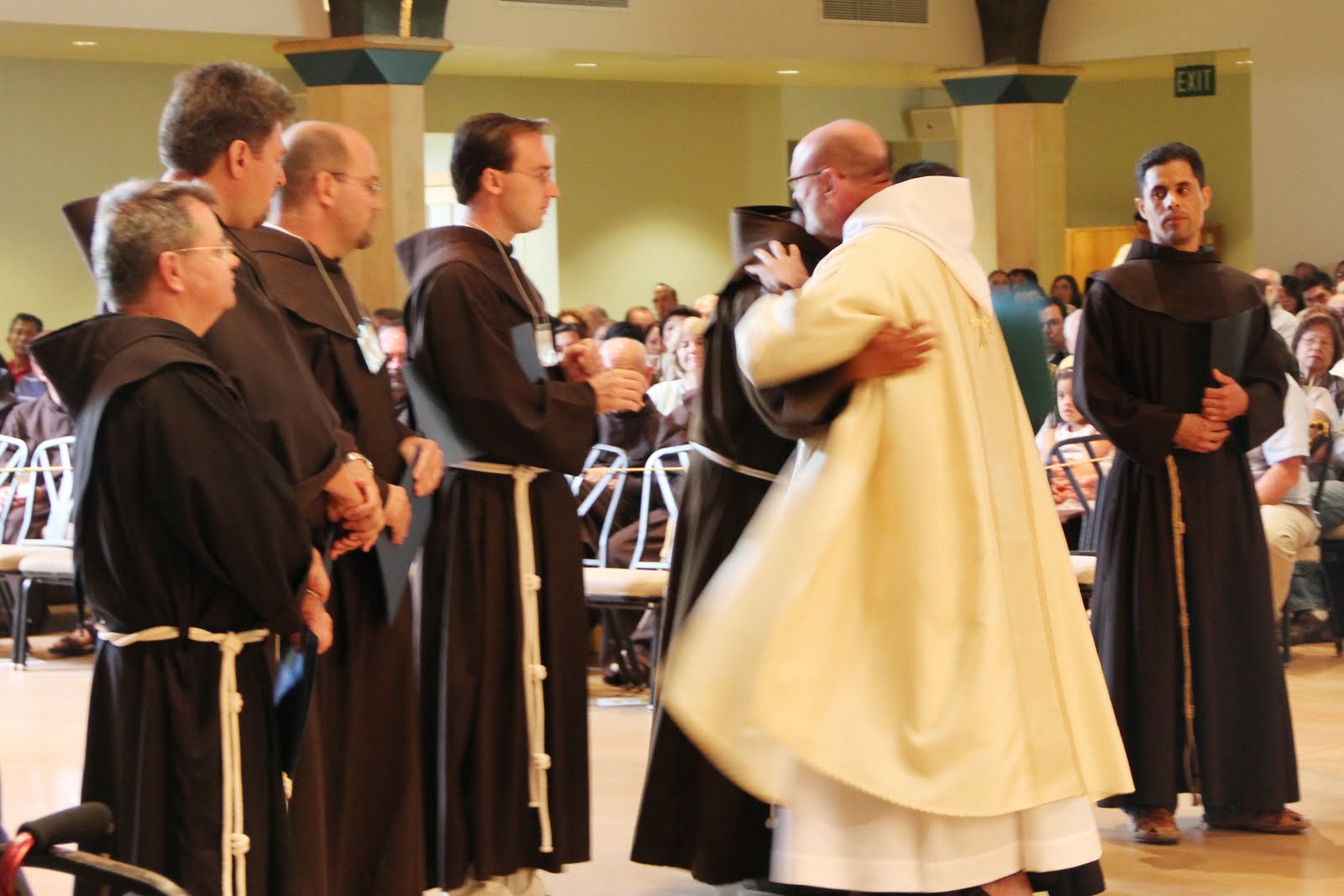
In the midst of all this scholarly and community activity, we celebrated a number of special public events as well. On Friday, August 13, our brother Sebastian David Sandoval-Ballestros was ordained to the transitional diaconate by Bishop Robert Brom, DD, of the Diocese of San Diego. Deacon Sebastian has since been assigned to the Franciscan Renewal Center in Scottsdale, Arizona, to complete his training in preparation for eventual ordination to the priesthood.

The following morning, our Minister Provincial Father John Hardin, presided over the profession of solemn (lifetime) vows by Friars Louis Khoury and Christopher Best in the Old Mission Church. The Church was filled to capacity with family, friends, and more than forty Franciscan friars—a record attendance for us. Besides being a monumental occasion for our professing brothers, it also served as a poignant reminder to all of us friars of what we have pledged to the Lord and our brothers:


“… with firm faith and will, I vow to God the Father, Holy and Almighty, to live the whole time of my life in obedience, without anything of my own, and in chastity….”

“Therefore, with all my heart, I entrust myself to this brotherhood, that through the working of the Holy Spirit, the example of the Immaculate Virgin Mary, the intercession of our father Francis and all the saints, and with the help of my Brothers, I may in the service of God, the Church, and humankind seek the perfection of charity.”

With the words “therefore, with all my heart,” I can assure you that we friars felt a collective lump in our throats. The promises made by every newly professed friar both reaffirm and challenge the commitment of us all. It is in grace-filled moments like this one that we realize that, our individual wounds and flaws notwithstanding, there is something (or rather, Someone) who brings us together and calls us to our better, even best selves.

Completing the triduum of Franciscan festivities, on Sunday, August 15, the Feast of the Assumption of the Blessed Virgin Mary, friars and members of the parish family of Mission San Luis Rey gathered at Eucharist to bless and dedicate our new Franciscan/ San Damiano Cross. The nine-foot long object “written” icon-style on a ‘body’ of solid pine wood is an interpretation of the same Cross from which the corpus of Christ spoke to St. Francis of Assisi nearly 800 years ago, enjoining him to “rebuild my Church.” Our brother, Vincent Nguyen spent two full months as artist-in-residence at the Parish working on the figure.


Minister Provincial Father John Hardin presided at sequential unveilings of the Cross at both the principal English and Spanish-language celebrations. He also received the renewal of temporary (annual) vows from our nine student/ simply professed confreres. At the end of Mass, the Parish Knights of Columbus Council 3162 presented scholarship awards to three of our student friars: Joe Sury, Louis Khoury, and Ryan Thornton.


After a weekend of liturgical celebrations and ensuing fraternal partying, our student friars stayed on at San Luis Rey to help out with ‘voluntary’ manual labor on a variety of unglamorous jobs on the grounds. Many thanks to them for their hard work in the gardens and elsewhere.

I’ve been told that next summer, the student friars will be with us at OMSLR for an even longer period of time. We welcome another friendly invasion. These men bring along with them the contagious passion, energy, and excitement of both their youth and their 'young' vocations. This, in turn, helps to re-ignite the Franciscan spirit among us; we are really blessed.

--Many thanks to Secular Franciscan Tuan Cao and to Brother Eric Pilarczik for the photos provided in this entry.- ct

Thursday, August 26, 2010

True Conversions No.12: Girl Meets God


Girl Meets God: A Memoir
Lauren F. Winner
Random House: New York
c. 2002, 310pp. US$15.00
ISBN: 978-0-8129-7080-
7

A graduate student with both high aspirations and admirable accomplishments (degrees from Duke, Columbia, Cambridge universities), Lauren Winner is what one might term a sequential convert. A child of a mixed marriage (her parents, Southern Baptist and Reform Jew respectively) from Charlottesville, Virginia, she first converts to Judaism while still in her teens. Several years later, she is baptized into the Episcopalian tradition of the Christian faith. All along and throughout her faith journey, she struggles to reconcile the tensions of both traditions within her. This memoir is the story of those interior struggles and the author’s efforts to “come home” both spiritually and culturally.

This all sounds very serious and ponderous. And it is. But at the same time, Winner brings a wonderful and totally unexpected element of mirth to her account. Simply put, she is very sassy and very funny. She is the first to see the irony in her own situation, which she is able to view with frankness, grace, and humor, despite some quite painful interludes.

“I had no epiphanic on-the-road-to-Damascus experience. I can’t tell my friends that I became a Christian January 8, 1993, or on my twentieth birthday. What I can tell them is that I grew up Jewish. I can tell them about the time I dreamed of Jesus rescuing me from a kidnapping; I can tell them I woke up certain, as certain as I have ever been about anything, that the dream was from God, and the dream was about Jesus, about how He was real and true and sure. I can tell them about reading At Home in Mitford, a charming if somewhat saccharine novel about an Episcopal priest in North Carolina, a novel that left me wanting something Christians seemed to have. I can tell them about my baptism.”


So begins Winner’s account of her spiritual journey, a journey which, initiated with her baptism, continues to unfold as she realizes the depth of pain her ‘divorce’ from Judaism has cost her. Both parents are perplexed; several members of her tight circle of Orthodox Jewish friends break off contact and shun her altogether; secular colleagues, are skeptical and patronizing. Only a few Christian friends-- including other converts from Judaism-- and her parish family at her All Angels church community provide a nucleus of support and encouragement for her newly claimed spiritual identity.

Tellingly, Winner is drawn to Christianity—and most particularly to the Anglican tradition—because of the Incarnation: “the idea that God lowered himself and became a man so that we could relate to Him better…. Christians, unlike Jews, spent their time talking to a God who knew from experience what it was like to get hungry, to go swimming, to miss a best friend.” Her insight into the Incarnation of Jesus provides a natural segue into an embrace of sacramental, most especially Eucharistic life: “I believe… receiving the Eucharist is the place where reality is most real. I believe it is the most important thing I do each week.” That said, she acknowledges “I have never felt God at the communion rail…. I keep hoping one day God will give me some feeling at communion. I figure he is helping me become something else…. He is calling me to a place where He is truer than everything else, truer even than how I feel.” Ultimately, all explanations and rationalizations aside, the individual experience and decision is what it almost always is—a literal leap of faith.

The organization of Winner’s memoir is of interest. She follows an entire Christian liturgical calendar, both beginning and concluding with Advent. Within each of the demarcated sections, she moves back and forth from the Christian event to a roughly simultaneous or roughly analogous Jewish celebration. Winner is every bit as steeped in Jewish history, culture, and theology as she is in her newly-embraced Christianity. Consequently her synoptic reflections are especially rewarding for the non-Jewish reader.

This book was first published in 2002. Winner formerly converted to Orthodox Judaism after high school. She was subsequently baptized into the Christian faith after her undergraduate years. This memoir was penned during her years as a graduate student and doctoral candidate. Where is she now in terms of her faith journey? Has the “divorce” she describes between her Jewish and Christian identities been resolved? Has she, over time, been able to integrate both traditions more harmoniously in terms of her spiritual practices and devotions? The spiritual memoir of this intelligent, inquiring, and deeply sensitive young adult certainly merits a sequel. This volume clearly concludes with a “to be continued” rather than a “happily ever after.”

Monday, August 16, 2010

True Conversions No.11: Faith Interrupted


Faith Interrupted: A Spiritual Journey
Eric Lax
Alfred A. Knopf: New York
c. 2010 275 pp. illus. US$26.00
ISBN: 978-0-307-27091-7 (hardbound)

“I came to the obvious but difficult-to-accept conclusion that my son’s perception of his religion was not at all unusual for a young person, and that what I wanted for him—a personal sense of the excitement of Christianity—was something he would have to learn for himself…. He would have to discover it and test it—verify it…and make it his own, in his own life, in his time, through his own encounter with the living God.”

So opines author Angelo Matera (Faith on the Edge), when confronted with the discomfiting knowledge that his teenaged son did not share his own religious convictions. Faith, we are given to understand, is a gift. Yet it never ceases to surprise and befuddle us that what we cannot seem to impart the essential DNA of our deepest beliefs to the next generation. The discovery and acceptance of faith must, ultimately, be a free, conscious and personal decision.

Author Eric Lax has written a deeply personal memoir on precisely this subject. He wrestles with the enduring conundrum of conscience and consciousness: that while he deeply respects the religious faith of others, he cannot accept that same faith for himself. In a way, this is not a memoir of Lax’s own faith journey. More aptly, perhaps it is the spiritual biography of the two people in his life he appears to admire most: his father and Episcopal priest John Martin Lax, and his best friend, George (Skip) Packard. The course of Lax’s narrative is partly a “coming of age’ narrative and partly a description of these parallel and simultaneous journies: Lax’s own gradual drifting away from belief, and his father’s (and Skip’s) increasing embrace of and commitment to the Christian faith.

Lax provides a loving description of the Episcopal liturgy which has framed and informed his worldview from his earliest memories as an acolyte assisting his father at Holy Communion at their parish in El Cajon, California, through his experiences at church school, then summer camp, and student years at Hobart College. Lax’s hold on the Anglican tradition is a heavily aesthetic one: the beauty of the liturgy captures his senses, imagination, and emotions. (There are several, unnecessarily long descriptions of liturgy as well as verbatim citations from the Book of Common Prayer) But, apparently, the aesthetic attraction has worn away with time. The faith of his father/s is not sufficient to address his deeper longings for meaning and understanding.

At the same time that Lax charts his own drift from Anglicanism, he records in admiring detail the growing faith of his college friend, Skip. Coming of age on the cusp of the Vietnam War, Lax struggles with the decision to request “conscientious objector” status based upon his religious beliefs, and serves a two-year stint of duty in Micronesia as a Peace Corp volunteer. Skip, meanwhile , joins the US Army, attends Officers Candidate School, and sees active combat. Upon his return from Vietnam, Skip enrolls in seminary and is ordained first as an Episcopal priest, and ultimately as a bishop.


The figure of Lax’s father, the dedicated, humble, and kindly priest, is always within close reach. Lax appreciates the depth and strength of his father’s (and Skip’s) convictions, but cannot embrace them himself. Doubt about dogma stands in the way. For his part, Lax gradually disengages from church attendance over time: the more he consults the creedal statements of the Church, the less willing he is to give assent to its doctrines. “… shortly after I turned thirty I noticed a drift away from my secure faith. It was a course of omission, not commission—of what I happened not to do rather than what I decided to do.” Lax’s stance is neither rebellious nor condemnatory of the church. It is simply a matter that the church is no longer relevant to his life: “I felt part of the Church, an insider in a genteel and socially prominent faith. Unfortunately, this meant that I found comfort more in feeling connected to the establishment than to the Holy Spirit.”

Interestingly, he seems to draw comfort and consolation from the wry wit of Woody Allen (Lax has written two books on the comedian’s life and work): “Woody’s conviction (and annoyance) is that as much as we might like there to be a personal God in a universe where wrongdoing is punished and virtue rewarded, we only kid ourselves into comfort by believing it. His aphorisms and observations about God (e.g., “I think the worst you can say about (God) is that basically He’s an underachiever.” ), religion and faith are widely quoted, in part because they’re pithy and funny and in part because they lead to reflection.”

The trajectory of Lax’s spiritual journey is not unique to his generation—women and men reared in a mainline Christian denominations who realize that the church no longer holds the hope, promise, or consolation of their formative years: “I wasn’t looking to lose it; I just suddenly noticed there was a separation I had never known. I was like a car whose tires all have imperceptible leaks. Everything runs smoothly, until suddenly four flats bring you to a halt.” The separation from that tradition and grounding elicits more nostalgia than bitterness; there is a quiet sadness and recognition of loss: “I still find myself at home in a church, but now it is more like revisiting the home in which I grew up.”

This is an honest account of one man’s spiritual experience, but it still leaves one wanting to push, delve, and discern more deeply on the nature of belief. “For all my childhood,” Lax writes, “it was as if faith were part of my DNA, determining but unseen.” “Faith, I guess”, he concludes,” is like love: It withers when unattended.”

True Conversions No.10: Faith At The Edge


Faith at the Edge: A New Generation of Catholic Writers Reflects on Life, Love, Sex, and other Mysteries
Angelo Matera, editor
Ave Maria Press: Notre Dame, Indiana
c. 2008, 224 pp. US$15.95
ISBN: 978-1-59471-140-4

“Just about every Catholic I know collects conversion stories, “ observes contributor Eve Tushnet, herself a convert. “… These stories usually have recurring patterns and themes… They’re often love stories; they’re often stories in which a sense of disturbance and inadequacy provokes a search for answers and the ‘answer’ to the questions is found in another person—or Person. They’re often stories in which an encounter with beauty forces an often unwanted recognition of a truth about oneself, one’s identity, and how one needs to relate to others.” Tushnet’s observation also serves as an apt commentary on this group of essays edited by Angelo Matera. It is a collection which on the whole describes, at times quite poignantly, aspects of both search and encounter central to the process of spiritual transformation and growth.

While not a compilation of “conversion stories” per se—themes run widely and sometimes wildly from young married life and parenthood to natural family planning, corporal mortification (!) and even a tongue in cheek consideration of exorcism—this volume nevertheless expresses in a significant way the spiritually transforming experiences of people who have in one way or another been challenged, confronted, and even surprised by faith at various moments in their spiritual journey. The conversion process here is less frequently a ‘once and for all’ struck-by-lightning kind of event, than an ongoing struggle and unfolding of actual, lived experience and engagement.

Religious experience and conversion are not the property of any one class, community or interest group. The Spirit blows where it will, whether right, left or center. According to editor Matera the seventeen writers whose work is represented in the 20-odd essays in this survey comprise “a new generation of Catholic writers.” While they may well represent part of a generation of Catholic writers, I wonder whether they actually comprise the full cohort. Many of the authors represented in this book are also in some way with the website GodSpy.com, inspired by the Communio/ Faith and Liberation movement with its roots in postwar Italy. Their perspective is that of a self-conscious orthodoxy and identification with the magisterium (official teaching authority) of the Catholic Church. There are very few strays. “What unites the writers of these essays, “ notes Matera, “ is a singular vision: a paradoxical desire to live according to the firm doctrines of their church while at the same time freely expressing the truth of their experiences, and the judgment of their consciences.”

That said, I found this collection of essays to be at times a fascinating melding of traditional theology with a remarkably fresh and free-- sometimes even a bit too free—expressive style. The insights may be traditional, but the voices are clearly those of contemporary Americans, often well-read, articulate and world wise. In the main, they tend to be artists rather than theologians.

The (perhaps unintended) leitmotif of personal conversion in this collection is present throughout the book. In the introduction, editor Matera notes: “I remember the specific moment that sparked my interest in the Catholic Church. It came from an unlikely source—a review of Pope John Paul II’s encyclical Veritatis Splendor by gay writer Andrew Sullivan in The New Republic…. Sullivan was repelled by what the pope wrote. But as a sincere Catholic he also found it difficult to resist the pope’s ‘bracing’ argument…. I was fascinated by the idea that anyone as traditional and doctrinaire as a pope could be intellectually challenging.”

“New Orleans made me a Catholic, or at least the kind of Catholic I am, “ writes Jessica Griffith in her poignant reflection on life in the Big Easy post-Katrina. “It always seemed to have body and soul—the sacred and the profane locked in constant embrace.” For Brian Pessaro, the experience of a Marriage Encounter weekend provided a spiritual epiphany: “I don’t remember much from that weekend, but I do remember one specific statement that the husband of one of the presenting teams said. ‘Love is not a feeling. Love is a decision. You have to decide to love your wife each day.” Pessaro continues later in his essay: “There was no theophany, no burning bush or pillar of fire. But over the course of the next year things began to change.” Paula Huston, describing her decision to complete the RCIA (Rite of Christian Initiation for Adults) process for full membership in the Catholic community despite some initial obstacles, concludes “I could have gone to another church… but an easier church might not do the job, might not be able to tame this thing in me that needed taming.”

The accounts and reflections in this survey are most convincing and powerful when they come directly and candidly from the people’s lived experiences. They are less persuasive when they appear to be polemical, rigidly self-justifying, or just a teensy bit “out there.” This is a mixed bag, but the mixture is interesting and worth exploring.//

Tuesday, August 10, 2010

True Conversions No.9: Thomas Merton: The Seven Storey Mountain


Thomas Merton
The Seven Storey Mountain
c.. 1948 (Anniversary Edition: 1999), 496pp.
Harcourt Brace: New York
ISBN-13: 9780156010863

I first read Thomas Merton’s now-classic spiritual memoir in 1980, when I myself was 30 years old. I had just arrived in New York City for what was to be a three-year stay; it was a geographic move that also coincided with an earnest spiritual search. Earlier that same year, I had made the decision to become more actively involved in my faith after a lengthy sabbatical from regular participation. Spiritually, I was eager, curious, hungry, and a bit scared. Serendipitously, I lived in the same Morningside Heights/ Columbia University neighborhood that Merton had inhabited four decades previously. And as I delved into his spiritual autobiography, I could trace my own personal Merton Trail down the spine of Manhattan: from Corpus Christi Church and the Columbia campus on the upper West Side to the depths of Greenwich Village. It was a wonderful journey: for myself, and no doubt for many others, Merton’s Manhattan served as a helpful point of reference and entry into the passionate quest of one of the great spiritual writers of our time. A quest which paralleled my own personal path of spiritual rediscovery and connection.

Since its publication in 1948 (Merton was himself 33 years old at the time and preparing for priestly ordination at the Trappist Abbey in Gethsemani, Kentucky), The Seven Story Mountain has sold more than three million copies—600,000 hardcover copies in the first year alone-- and is still in print. This summer, at the age of 60, I decided to re-read The Seven Storey Mountain to see what kind of impression it would leave this time around.


The Thomas Merton of 1948 was a passionate, even somewhat uncritical apologist for Catholicism. He maintained all the fervor of the neophyte—a spiritual enthusiasm which led him from a promising literary career ‘in the world’ to an equally fulfilling literary career while a Trappist monk. Merton’s early life as described in this memoir is a mixed tale of privilege, struggle, suffering, numerous detours, constant searching and ultimate satisfaction in a religious faith and identity. He was born in France in 1915, the first child of an artistic family—his father was a successful painter. His parents were of Canadian/New Zealand nationality with strong connections to both England and America. His was a childhood and youth marked both by tragedy (the early deaths of both parents) and frequent familial disruption and upheaval. Merton’s formal academic education in English public schools and later at Cambridge and Columbia University, was rounded out by ongoing travel and family visits through Europe, England and the United States. As studies and travel involved an intimate immersion into European culture, young Merton moved gradually from an early attraction to Catholic culture to an eventual embrace of the Catholic faith.

Merton’s spiritual ambit, however, was no perfect trajectory by any means. Rather it was marked by painful periods of confusion, reticence, and self-doubt—with heavy doses of adolescent angst and self-absorption. By his mid-twenties, however, Merton had found his spiritual home and entered into the protracted spiritual honeymoon that resulted in this memoir. His was the pre-Vatican II Church— frequently perceived by its faithful as a morally impregnable fortress and bulwark against the seductions and depredations of a decadent culture. It was a world that spoke of certainty, security, and order to its denizens— an environment no doubt especially attractive to a sensitive and intellectually precocious young man who had experienced precious little real stability during his own tumultuous upbringing.


Today, Merton’s narrative stands on its own—even at a distance of six decades-- as a poignant prelude to the ongoing search and spiritual growth of a man who, even from the distance of the more than 40 years since his death in 1968, continues to be admired for his soaring intellect and deep spiritual insight. Its abiding strength and appeal lies perhaps in Merton’s utter sincerity and dogged determination to plumb the depths of his own soul.

I tried, in my own re-reading of Merton, to put aside anything I had heard or read about him in order to have as fresh and unbiased experience as possible. I found myself full of admiration and respect for a young man who, obviously, had suffered so much in his early years. Yet, I could also see the somewhat spoiled and entitled youth of the British and American upper classes who, seemed to sail effortlessly (and literally) across the Atlantic at a time when most Europeans and Americans were struggling to keep body and soul together during the depths of the Depression. Merton’s first direct experience of genuine poverty, in fact, came as a volunteer at Harlem’s Hospitality House, founded by the celebrated Catherine (Baronness) deHoeck just a few years prior to his entry into the monastery. His conversion occurs at a rather high altitude as well: exposure at Columbia to a gifted teacher and mentor, literary critic and anthologist Mark van Doren: his collaboration and friendships with other budding young writers at their periodic encampments in Olean, New York; his rapturous embrace of William Blake work as a topic for his master’s thesis.

But Merton is certainly more than the sum total of his class and relatively privileged background. His initial immaturity and naivete notwithstanding, there is something more to Merton—“something’ which impels him further in his spiritual journey. This is the part of SSM that not only ‘reads’ well today; it also continues to move and inspire the contemporary seeker even at a distance of more than a half-century.

I have to mention, by way of a postscript that there is also a Franciscan dimension to Merton’s spiritual journey. Initially attracted to the Order, he discerned with the friars, but withdrew his application to postulancy after having been dissuaded by his would-be superiors. Merton is rather vague about his reasons for not joining the friars, but the decision did not deter him from teaching for a while at St. Bonaventure’s University before his eventual entry into the Trappists. I can’t help thinking how both Merton and the Franciscans might have been affected had he decided to become a son of St. Francis. We’ll never know!//