Sunday, January 19, 2014

Homily for 2nd Sunday in Ordinary Time: Behold the Lamb of God!


When it comes to faith, believing is seeing.  And not the other way around.
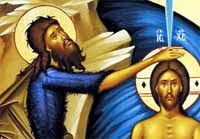
What a difference a week can make.  Even when  it comes to Scripture.  If today’s Gospel account sounds familiar, it’s because it is. It is exactly the same Gospel account as last week’s:  the story of the Baptism of the Lord. The only difference, however, (and it’s a significant difference) is that last week’s account is from the Gospel of Matthew (chapter 3) and today’s story is from the Gospel of John (chapter 1).

Matthew’s account is fairly straightforward.  Neither the narrator nor any of the characters get in front of the camera or block our view of the Baptism of Jesus by his cousin John.We hear  the words of Jesus.  We hear the words of John the Baptist.  We hear the words of God the Father, together with his Son Jesus and in the Presence of the Holy Spirit.  It’s all there, right in front of us, with all its drama and immediacy.

But John’s Gospel gives us a very different twist.  John does all the talking.  All  the talking.  He is off-camera.  It’s almost as if he were being interviewed alone, sitting calmly and comfortably in someone’s home or garden. (Or more likely in his case, squatted in a dank prison cell awaiting his execution).   Nevertheless, John is reflecting on an experience of Jesus.

What is going through John’s mind and heart as He sees Jesus coming toward him?  First of all, they were not strangers.  We know from elsewhere in Scripture that John and Jesus have been intimately connected their entire lives:  They were cousins. Born just six months apart.  Their mothers were very close-- so close that Mary, pregnant herself with Jesus, travelled a great distance to see Elizabeth, the mother of John, and to stay with her during her confinement.  And we know that both mothers intuitively knew that there was something very special about these births.  Especially  the birth of Jesus.  And that John even leapt in his mother’s womb when the two women met.

That’s the back story.  Or only a part of it.  They were family, blood relatives, the same age.  They had to have grown up together.  Visited each other, seen each other at family weddings and funerals.  Played together as kids.  So. Why, then, does John not say (or think):  Oh.  Here is my cousin, my kinsman, Jesus!  What brought him here to the Jordan today?  Is he coming to be baptized as well?  Well, I’ll be….  No.  John says (and thinks and feels):  It’s Him.  He is the One.  I’ve always known there was something special, something different about him.  And I’ve been watching him carefully all these years.  It’s Him. The One who has existed  before all time.   The Promised One.  The One I have been told about in answer to my prayers.  The One I have been instructed to watch out for.  It’s Him!  It’s the Messiah! 


I used to know him as just my cousin.  But now I see Him for who He really is.  He is the Lord.  So I called him the Lamb of God.  That was the first thing to come to my mind.  And, actually, it fits him.  Perfectly.  Now that I think of it.  After all, lambs are sacrificed daily in Temple worship.  But there is only One Lamb—for whom we have been waiting—to fulfill and complete all of our symbolic rituals.  It was the lamb our ancestors smeared on their door lintels at Passover which secured our liberation from the slavery of Egypt.  And, now here is God’s very own Lamb, who will one day be sacrificed for our account.

What does this all have to do with you and me?  When it comes to faith:  Believing is seeing.  And not the other way around.  John saw Jesus.  A lot.  Throughout his live, presumably.  But it was only gradually, over time, that John began to believe Jesus.   And to believe in Jesus.  And that is Good News—Great News, even—for you and for me.

Believing is a process:  day by day (sometimes even moment by moment) over time by which we come to see the presence of Jesus more clearly in our lives and in our world.  And in ourselves as well.  It takes time and energy and commitment and discipline to cultivate this awareness and receptivity.
Belief grows through prayer. Through study.   And reflection/ meditation. It grows, gets tested (and either strengthened or weakened) through  our interactions and relationships with other people on a daily basis.
It is renewed, refreshed, and regenerated through community.  And for us, in our Catholic Christian tradition, through the life of the sacred moments—the sacraments we share.  Most especially and beautifully through the Word and Eucharist we share.


We can lose our faith, watch our beliefs shatter and crumble.
Or we can hang on, hang in, lean into our beliefs in good weather and in bad. Often until  the storms pass.  Until, like John, we gradually begin to see.  Jesus is the Lamb of God.  And He does take away the sins of the world.

Happy are we who are called to the supper of the Lord…. When it comes to faith, believing is  seeing.//

Sunday, January 12, 2014

Homily: The Baptism of the Lord


Today is the last day of Christmas. To prove it, I am holding in my hand the last poinsettia of Christmas.The time for poinsettias is over.  The same goes for Christmas trees. If you’ve been secretly holding onto your Christmas tree in a corner of your house  until  now, please let it go. Before the Fire Department has to deal with it in another way. Seriously, though, the Church has been holding onto Christmas for three full weeks now.  Not in any secret way, but in a quite deliberate and public fashion no matter what anyone thinks.

Because Christmas is a season.  A time whose power and beauty are so immense that we cannot unwrap it, unpack it , and admire it all in a single day.  And then exchange it for something else on the next.  And we dare not do so. Instead, we stretch out our Christmas to make it last as long as we can.  Right from the birthday of Jesus through the feasts of the Holy Family, Mary the Mother of God (aka New Years Day), the Epiphany, and today.

Today, we celebrate the Baptism of the Lord. A baptism is a bath. A ritual bath started by the cousin of Jesus, John the Baptizer, as a public gesture of a personal decision to ask for forgiveness and to change one’s life. In today’s Gospel from Chapter 3 of Matthew, we encounter Jesus standing in line with everyone else to accept a ritual cleansing, or baptism, from John.

John is both famous and feared.  He is acknowledged— even by his enemies—as a genuine prophet.  The first authentic prophet  to be raised up among the Jewish people in centuries.   His mission and ministry were credible because he walked the talk.  His  ascetic and prayer-filled lifestyle matched his words.  John surprised, intrigued,  and fascinated people. He did not seek to raise up an army or declare any sort of violent insurrection.  Rather, he preached a life of repentance and of conversion.  So people, hungry for authentic change in their lives, came to John.  Even to the boondocks beyond the capital, Jerusalem.  Hungry for change, they lined up to make a public acknowledgment of their sins and to accept baptism at his hands.

Now I can imagine that there were two lines for this baptism.  The first line was the “IN” line:  with a great number of people looking quite nervous and tentative.  Sheepish,  even.  These were the obvious sinners-- the people about to receive their baptism from John.  The other line  was the “OUT” line:  of people were those who had just been baptized.  They were all grins as they were handed towels, dried off, and got ready to celebrate with their friends.

Jesus decided to get into line with everyone else.  But He got into the “IN” line instead of the “OUT” line.  Why in the world did Jesus get into the wrong group?
After all, Jesus was not a sinner. He did not need to be baptized.  So, why did He get into the wrong line? This is where the Scriptures start to stutter.  Members of the early Christian community certainly found the presence of Jesus in this scenario both embarrassing and disconcerting.


Matthew tells us there was a discussion between John and Jesus.  John was reluctant.  You bet he was.  And Jesus was insistent.  Stubbornly  so.  In the only way that one cousin can be with another.  People were waiting, fidgeting.  And they were at a stalemate.

Then Jesus said he had to be baptized so that ‘all righteousness might be fulfilled.’
What does that mean? He was talking in code.  A ‘righteous’ person was one who was completely open to God’s will. More  than that.  A person who makes the decision to surrender completely  to God’s Presence and Power in his life.

Jesus, in the 30th year of His life, had finally attained the status of full adulthood as a Jewish male.  With His baptism, He proclaims for the first time His complete openness to God’s will—to the will of His Father—in His life.  Finally,  John relents and baptizes Jesus.  And then, something radically new and extraordinary happens.

In this ritual breaking through from death to life, Jesus breaks through to heaven.  The barrier between heaven and earth is pierced.  And God, in the presence of the Spirit, acknowledges His Son.  And by extension, God acknowledges and blesses us.

The baptism of Jesus changed absolutely everything.  He didn’t get into the wrong line on purpose for His own sake.  He did it for ours. He wanted to show that His greatest desire was to be right down here among us, close to us, as one of us.  And that changes everything.  It means our own baptism as Christians can never be the ritual, symbolic baptism of John.  Ours is the baptism of Jesus. In Jesus. And through Jesus. So, when we are baptized—once and for all—the heavens open for us as God claims us as His own.  Once and for all.  Once and for always.


Our baptism is the beginning of our special life with God in the community of faith, the community of the friends of Jesus.  It is not just a single, historical event.  It’s more like a time-release capsule.  It’s power is so strong and enduring that, like the prolonged Christmas season itself,  it releases itself throughout our lives.  Not just in a single spiritual photo op.

It is the power of identity.  Of being and  belonging.  To God and to His People.  Of knowing who we really are and whose we are, no matter what we do or say or what happens to us in our lives.  It is so powerful that it transcends the petty differences that separate one group of Christians from another. After all, there is only one baptism in the Lord.  It’s so powerful we can’t even take it away from ourselves.

We are first, last, most and always children of God, members of a family of faith.  Baptism is our birthright as Christians and no one can ever take it away from us.

So that what the Father says to and about Jesus, the Father says to us and about us:  “This is my beloved son. This is my beloved daughter.  You are my beloved son.  You are my beloved daughter.  In whom I am well pleased.” And He IS pleased with us.  Very pleased indeed.  So pleased that he sent His Son as our Shepherd.  To be in our midst. Jesus was baptized and the heavens opened.  But after that, Jesus stuck around and is still with us. It is our lasting Christmas gift on this last Christmas Day.


Monday, January 6, 2014

A Homily for Epiphany


Today we celebrate the Feast of the Epiphany, the visit of the Magi to Jesus in Bethlehem.  If  you were in New Orleans this time of the year, someone might offer you a slice of King cake. And if you knew what it was for, you would be very careful about accepting a slice.  And even more careful about biting into it.
Because, somewhere within each of these ring-shaped confection studded with candied fruits and nuts, there is a teeny-tiny plastic figure of the Baby Jesus.
And if that teeny tiny plastic figure is in your slice, you are elected to give a party for your family and friends during the Mardi Gras season, which starts about now and continues until Mardi Gras,  Fat Tuesday, the day before the start of Lent.

The Epiphany and Mardi Gras extend the celebration of Christmas and throw off the gloom of January and February chill and blues. Not Christmas Day, though, that is, because that feast was over about 4pm on December 25.  But rather, the Christmas season—a period of celebration and reflection often-neglected and overlooked even by believers.  Ready or not, though, it’s where we are as Church—and the season of Christmas officially ends next Sunday with the Baptism of the Lord.

 So, in this extended season, today we celebrate the wonderful feast of the Epiphany of the Lord.  We know it as Little Christmas, or the Visit of the Magi—the Three Kings—to the infant Jesus. We know and love the story  well — right down to the names of the Magi Kings—which aren’t even in Scriptures even though they maybe ought to be. Three (were there really three?) Kings (were they really Kings) came from the East (where in the East?  Does anyone know?) Following a star (was it a star or a super-nova of some kind?) to find the one born as King of the Jews.

We are told that after their encounter with the cagey and crafty evil King Herod (and he really was both, I can tell you for sure), they encountered Jesus the King in Bethlehem and presented him with gifts befitting the dignity of a monarch (gold, frankincense, and myrrh). Totally  uninteresting for an infant.  And mostly unpractical (except for the gold, which would certainly have come in handy) for his parents.  Then, we are told that they were informed in a dream not to return to Herod, but to return to their country—to return home—by another way.

It’s this “other way” that intrigues me most, personally.  How could anyone, after having been on such a great journey of faith and discovery, ever be quite the same again?  It’s like spending a month in Antarctica.  Or taking five years to sail around the world.  Or Christmas at Yellowstone Park watching the capture, tagging, and release of wild wolves. Or climbing the face of El Capitain.  You can be sure of a few things:  You would never ever forget such an experience.   You would  never ever stop talking about it.  And it would change your life-- not just once and for all, but once and for always for your entire life.

That’s what an encounter with God—a genuine encounter with Christ—does for us as believers.  It transforms our lives, changes us, makes a real difference for all of our lives.  We call that encounter a conversion.  For some people, it’s contained in a discrete event—a moment of intuitive wonder, perception, and discovery.  It could happen through a serious illness, a near-miss in an otherwise fatal accident.  A pilgrimage.  Or just a simple moment of prayer when you realized Someone was actually listening to you.

For most of us, though, it’s a much more subtle and gradual process. The progress may seem slow, subtle, and insubstantial.  And it is.  But over the long run, we reflect and realize:  things have shifted and we can never ever go back. 
Never back to our old ways, the old emotional and spiritual neighborhoods (or countries) of our lives.

For someone who makes the decision to stop some crazy behavior involving any sort of addictive detour—negative, destructive behavior of any kind—there is the hope and promise of Epiphany. For someone who has decided to let down their guard and let other people into their lives—healthy and affirming people—there is the promise of Epiphany.  For someone who stops cackling on and on in a dreary mantra of fixed beliefs and preconceptions about the way the world and other people operate—and opens him/herself to another, more spiritual dimension of life—there is the promise of Epiphany.

For the believer, who decides to take the Scriptures to heart—to read, meditate, ruminate on its significance in in their lives—there is Epiphany.  And for us Catholic Christians, in particular, to stop and consider that the Communion we bear and share is Christ the Lord present among us here and now, there is Epiphany here and now.


This is what The Epiphany is all about.  The recognition that God lives in our world.  And in each and every one of us. That Christ is for everyone. Everywhere.  Any time and all the time.  Period.  Sooner or later.  Quicker or  more slowly.  Here or somewhere else.  There is the promise of the Epiphany of the Lord.  Even right now.  Yes, even right now!//

Wednesday, January 1, 2014

Homily: Solemnity of Mary, the Mother of God


Good Morning!  And Happy New Year!
It’s so good to see so many of you here today.  Of course, I am curious and have a lot of questions.  But I don’t want to embarrass you or myself, so I will try to phrase them in the most general way possible.  You don’t even have to raise your hands; just nod you head.  Okay, Question Number 1:  How many of you have either personally, or have known someone in your life who has made a New Year’s Resolution?  Okay.  Great.  Now, did any of those resolutions ever concern losing weight and getting into shape?  Or involve giving up something—like smoking or drinking alcohol?  You know, this is a great time for gyms and health clubs.  In January, everyone else has to deal with credit card statements from Christmas and all of that.  But the gym folks are counting on people buying year-long memberships and then quitting before February.  So they’ve got eleven months they can spend here on the beach in Santa Barbara, or in Kauai, or someplace else.  It isn’t fair, is it?

 Now, let me ask you:   how many of you, one year later, can honestly say that you have kept your New Year’s Resolution from 2013?  (No hands).  Thank you!  Now I don’t feel so bad.  Because I didn’t keep my resolution either!  So I don’t feel so bad.  Experts tell us that it takes a great deal to make a resolution stick.  We make resolutions as an act of our wills, and then, to our sorrow, realize sooner or later how weak and wobbly our wills really are.  We just can’t do it alone.  We are told that one of most important things we can do in making a resolution is to tell everyone about it, so they will hold us accountable.  Even more importantly, though, we need a support system, people around us who will encourage us in our decisions and help us to start over again if/ when we slip along the way.  We just can’t seem to make this sort of promise and keep it.

Our faith tradition gives us an entirely different perspective on making promise, though.  It actually turns our conventional wisdom upside down.  We are not so concerned with keep promises as we are in allowing Jesus, our Promised One, to keep us!  It’s not a matter of making up our minds and having our own will.  Rather, it is a function of surrendering our will to God and trusting that, just maybe, God might know what is better for us than we ourselves think.

That’s why it’s so instructive to enter into the sense of the Gospel of Luke today, on the Solemnity of Mary, the Mother of God.  Mary made and kept her promise to God, but the Promise of God in Jesus also “kept” Mary, enabling her to trust God ever more deeply through the struggles of her life throughout her life.

Most of the stories we know about Mary come to us from the Gospel of Luke.  We have a very solid tradition which tells us that Mary shared her stories with the community of Luke and that they were subsequently included in the Gospel text.  It makes sense, doesn’t it?  How else would we know what we do about her? 

It’s as if we can hear her own voice in the “voice” of the Gospel, as she pondered all that had happened to her:  “There was the moment when the angel Gabriel asked me to be the mother of the Savior.  And I had to just stop for a moment to try to think it all through.  And all that it would mean to me.  Then, I went to see my cousin Elizabeth and the baby (John) leapt in her womb when we met.  And now, with the birth of the Child and these shepherds barging in out of nowhere—looking bad and smelling worse.  But when they saw Him, Jesus, they were absolutely transfixed and transformed.  And I had to stop and think again—ponder—about what all of this has meant.  How the promise of God has been unfolding in my life in ways that I never expected or could ever imagine.”

Mary’s narrative continues throughout Luke and the Acts of the Apostles.  We can experience her impressions and reactions to significant events throughout her life with Jesus, as she “ponders” in retrospect:  “Then, there was the day Joseph and I took the Child to the Temple for His name day and circumcision.  And Simeon told us that He would be the ‘rise and fall’ of many nations.  And how he turned to me, then, and predicted that a sword would pierce my heart.  I had no idea what he meant that day, but years later, when our Son was about twelve and we went to Jerusalem and thought we had lost Him.  Then, I remembered what Simeon said and I was worried sick and devastated that we had lost Him.  But then, here he comes skipping along like nothing had happened, and when He told us the things he had said to the scribes, I thought to myself:  “Where did He get all of this?  We didn’t tell Him these things?  He couldn’t have picked it all up in a place like Nazareth.”  Again, I really had to stop to think.  And ponder.”


“And then, years later,  there was this wedding we went to in Cana.  And I noticed how they were running out of wine and I thought, well, this couple is going to be really embarrassed.  And I turned to Him and mentioned it to Him.  And when he started to react, I just gave Him that look, and He helped.  I had no idea He was going to turn all that water into wine.  But when I saw what had happened, I just had to stop and think. And ponder.”

“Of course, He broke my heart.  And more than once.  Once, I went to hear Him preach and when someone told Him I was waiting outside along with some other family members, He came out with this, “Well, my mother and brothers are those who keep my Word,” and, of course, I was stunned and hurt.  And then I thought it over and realized, okay, He doesn’t belong to me anymore—if He ever did.  Now He belongs to everyone and I’ve got to step back and let Him go.”

“The worst part, though, was when they came to arrest Him.  And then tortured Him, mocked him, and put Him through this phony show trial before they marched Him off to His Death. When I stood at the foot of that Cross, I felt myself dying right along with Him.  And it took everything within me—everything—to hold onto that last slim thread of the promise God had made to me about him even before He was born.  I just wanted to die.  Right then and there.”

“And then, finally, when I was sitting in the room with His friends.  Friends?  Almost all of them had run off and abandoned Him when He really needed them.  But, never mind, I was there.  And then, all of a sudden, I felt the warm rushing wind of His Presence and Spirit.  And then, and only then, I finally was able to put together everything I had known and experienced about Him and realize how little I really new or understood from the very beginning.  It all had to play out over His lifetime and mine.  And I had to think it all through, carefully, until I saw the sense of it.”

Mary pondered.  She made a promise.  She kept her promise.  And God most certainly kept His Promise to her.  In Jesus.

And so it is with us.


Homily given at St. Barbara Parish, Old Mission Santa Barbara, Santa Barbara, California.  January 1, 2014